


How Long Was the Hundred Years’ War?

Despite its name, the Hundred Years’ War didn’t last 100 years at all. It actually stretched on for 116 years, from 1337 to 1453. Even then, it wasn’t one long, uninterrupted conflict, but a series of wars, truces, and skirmishes between England and France.

So, How Did It All Begin?
The trouble started when English kings tried to tighten their grip on lands they held in France, while French kings pushed back, determined to reclaim those territories. Things came to a head in 1337, when King Philip VI of France declared that Edward III of England had lost his right to the duchy of Guyenne (part of Aquitaine). Edward responded by doing something bold—he claimed the French throne for himself.
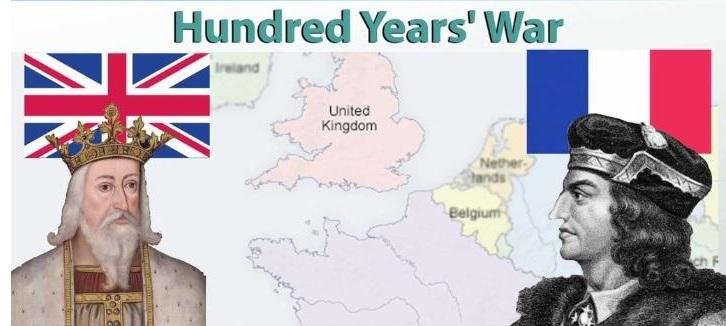
And just like that, war broke out.
Early Battles and the Fall of the Knight
One of the first major English victories came at the Battle of Crécy in 1346. Against all expectations, English archers armed with longbows devastated a much larger French army of mounted knights. It was a turning point in medieval warfare and marked the beginning of the end for the dominance of heavily armoured cavalry on the battlefield.
More fighting followed over the decades, with both sides gaining and losing ground. There were also long pauses in the action, including a major truce in 1396, when Richard II of England and Charles VI of France agreed to stop fighting for 20 years.
Famous Battles and the Final Act
The war flared up again in the early 1400s, producing another famous clash—the Battle of Agincourt in 1415, where English forces once again stunned Europe with a dramatic victory.

The conflict finally came to an end in 1453, when the French defeated the English at the Battle of Castillon. By then, France had reclaimed almost all the disputed territory, effectively ending English ambitions on French soil.

Did It Really Ever End?
From a French point of view, the war was over in 1453. But the story didn’t stop there. The English held on to the port of Calais until 1558, and English monarchs continued to claim the title “King of France” until 1800, when King George III finally gave it up.
Some historians even argue that the roots of the conflict go back much further—to 1066, when William the Conqueror, a French duke, became king of England. That single event tangled the two crowns together in centuries of rivalry, marriages, and territorial disputes.
Final Thoughts
The Hundred Years’ War lasted far longer than its name suggests, reshaped medieval warfare, and permanently altered the relationship between England and France. It was less a single war and more a long-running feud that echoed through European history for centuries.


- News & Current Affairs
- Business & Economy
- Finance & Money
- Education & Learning
- Technology & Innovation
- Science & Environment
- Health & Wellness
- Food & Drink
- Home, Garden & Lifestyle
- Travel & Tourism
- Fashion & Beauty
- Art & Culture
- Entertainment & Media
- Sports & Recreation
- Personal Growth & Lifestyle
- Careers & Work
- Tutorials & How-To Guides
- Real Estate & Property
- Automotive
- Family & Relationships
- Environment & Sustainability
- Law & Legal Matters
- Gaming & Esports
- Religion & Spirituality
- Community & Local Voices
- Miscellaneous
- History