


Crocodiles: Ancient Predators Built for Survival
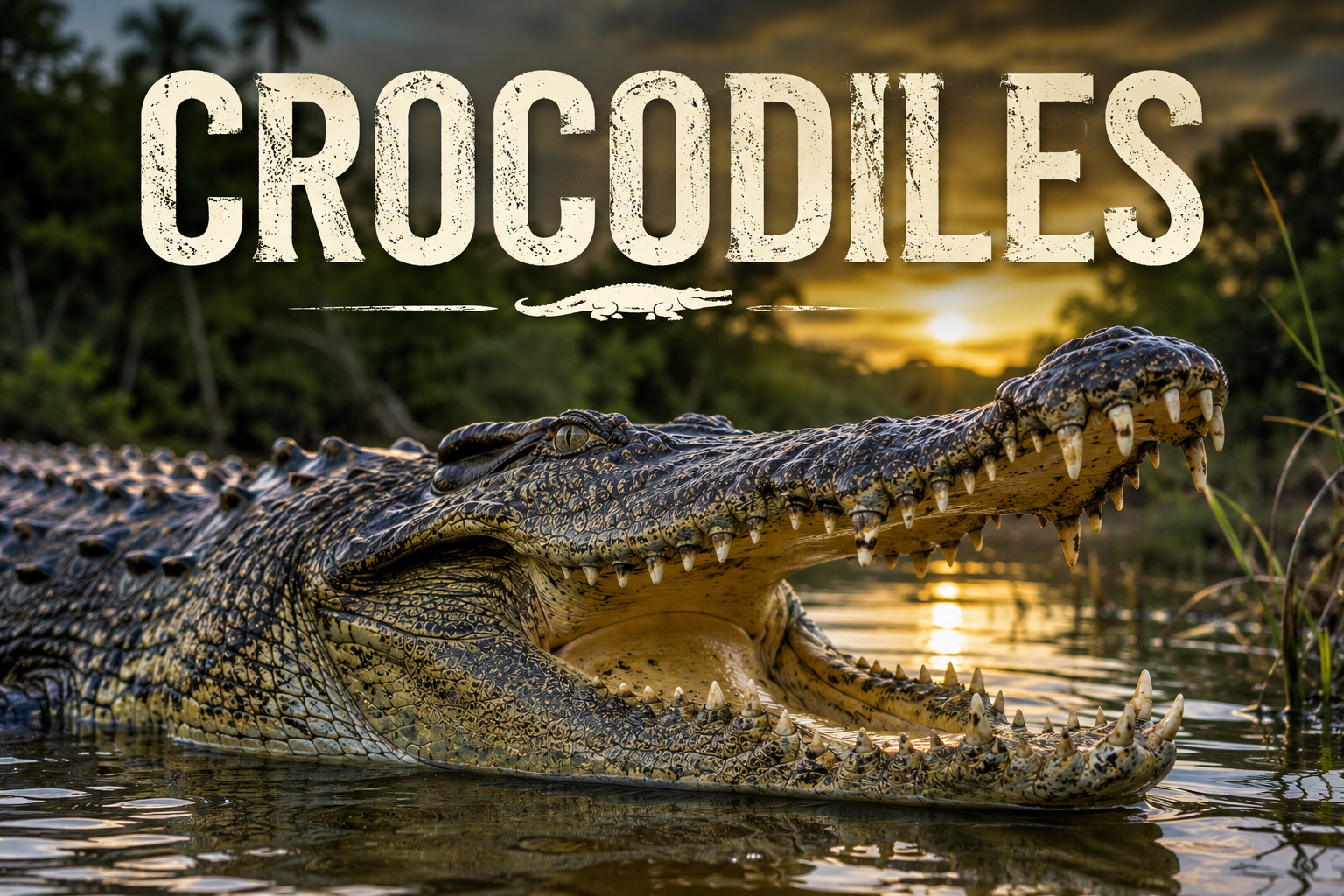
Crocodiles are among the most powerful and successful predators on Earth. With heavily armoured bodies, enormous jaws, extraordinary senses and an ability to disappear almost completely beneath the water, these ancient reptiles seem perfectly designed for ambush hunting.
Their ancestors lived alongside the dinosaurs, and crocodilians have survived dramatic changes to our planet over millions of years. Today, true crocodiles inhabit warm regions of Africa, Asia, Australia and the Americas, where they play an important role as predators in rivers, wetlands, estuaries and coastal ecosystems.
Physical Description
Crocodiles have long, low bodies covered in tough scales, short powerful legs and enormous muscular tails. Their streamlined shape allows them to move surprisingly gracefully through water despite their bulky appearance.
Head and Powerful Jaws
One of a crocodile's most recognizable features is its elongated snout. True crocodiles generally have a more V-shaped snout, compared with the broader, more U-shaped snout commonly associated with alligators.
Their jaws contain rows of sharp, conical teeth designed for gripping rather than chewing. In many crocodiles, the large fourth tooth of the lower jaw remains visible when the mouth is closed.
Their eyes, ears and nostrils are positioned near the top of the head. This clever arrangement allows a crocodile to remain almost completely submerged while still being able to see, hear and breathe.

Natural Body Armour
A crocodile's skin is thick, tough and covered in scales. Along its back are bony plates known as osteoderms, which provide additional protection.
Colours vary between species and habitats, but olive, grey, brown and greenish tones are common. These earthy colours provide excellent camouflage in muddy rivers, swamps and vegetation.
Crocodiles also possess extremely sensitive structures in their skin that can detect tiny movements and pressure changes in the surrounding water.
Size and Weight
Crocodilians vary enormously in size.
Some smaller species grow to less than two metres, while the Saltwater Crocodile (Crocodylus porosus) is the world's largest living reptile. Exceptional males can exceed six metres in length and weigh more than 1,000 kilograms.
Male crocodiles are generally considerably larger than females of the same species.
Their enormous size is especially impressive considering how quickly such a large animal can accelerate when attacking from close range.
Unique Adaptations
Eyes, Ears and Nostrils Above Water
Because these sensory organs sit high on the skull, almost the entire crocodile can remain hidden beneath the surface. To unsuspecting prey, only a pair of eyes and nostrils may be visible.
A Protective Third Eyelid
Crocodiles have a translucent nictitating membrane, or third eyelid, that helps protect their eyes underwater.
Watertight Features
When submerged, crocodiles can close their nostrils and protect their ears against incoming water.
A specialized structure at the back of the mouth also helps separate the airway from the mouth, an important adaptation for an animal that frequently captures prey in water.
Incredible Water Sensors
Tiny sensory organs around the jaws can detect remarkably subtle disturbances in the water. These receptors help crocodiles detect movements from nearby animals, even when visibility is poor.
Powerful Tail
A crocodile's enormous muscular tail provides most of its propulsion underwater.
With sudden sweeps of the tail, a crocodile can accelerate rapidly or launch part of its body from the water.
The Famous Death Roll
Crocodiles have teeth designed to grip rather than chew. When dealing with food too large to swallow whole, they may grip it firmly and rotate their bodies in a behaviour commonly called the death roll, helping them tear away manageable pieces.
Teeth That Keep Being Replaced
Crocodiles continually replace worn or damaged teeth throughout much of their lives. New teeth develop beneath existing ones, ready to replace those that are lost.

Distribution and Habitat
True crocodiles occur naturally throughout tropical and subtropical parts of Africa, Asia, Australia and the Americas.
They occupy an impressive variety of aquatic environments.
Freshwater Habitats
Many crocodiles inhabit:
- Rivers and streams
- Lakes
- Swamps
- Wetlands
- Floodplains
The Nile Crocodile (Crocodylus niloticus), for example, is widespread through much of sub-Saharan Africa.
Estuaries and Mangroves
Some species tolerate brackish and saltwater environments extremely well.
Mangrove forests, coastal lagoons, estuaries and river mouths provide excellent hunting grounds because they contain abundant fish, birds and other animals.
Ocean Travellers
The Saltwater Crocodile is particularly remarkable because individuals can travel considerable distances through marine waters.
Rather than continuously swimming against strong currents, crocodiles can take advantage of favourable tides and currents to move between coastlines, rivers and islands.
Behaviour and Social Structure
Crocodiles are often imagined as completely solitary reptiles, but their behaviour is considerably more complicated.
They communicate, establish dominance relationships, tolerate other crocodiles under certain circumstances and sometimes gather together at important feeding or basking areas.
Dominance
Size plays an important role in crocodile society.
Large males can dominate prime sections of habitat and may receive priority access to desirable basking, breeding or feeding locations.
Smaller individuals generally avoid challenging much larger animals.
Communication
Crocodiles communicate using an impressive combination of:
- Bellows
- Grunts
- Hisses
- Head movements
- Jaw movements
- Body postures
- Water vibrations
During breeding periods, large males may produce deep bellows that carry considerable distances.
Even baby crocodiles communicate before they hatch.
Diet and Feeding
Crocodiles are carnivorous opportunistic predators. Their diet changes dramatically as they grow.
Hatchlings
Young crocodiles commonly feed on:
- Aquatic insects
- Small fish
- Frogs
- Crustaceans
Juveniles
As they become larger, they begin catching bigger fish, reptiles, birds and small mammals.
Adults
Large crocodiles may prey upon:
- Fish
- Waterbirds
- Turtles
- Reptiles
- Antelope
- Wild pigs
- Other mammals
Very large species can overpower surprisingly large prey when an opportunity arises.
Crocodiles may also scavenge carcasses.

Masters of Ambush
Crocodiles rarely need to chase prey over long distances. Instead, patience is their greatest weapon.
A crocodile can remain almost motionless beneath the surface, sometimes with little more than its eyes and nostrils exposed. When an animal approaches the water's edge, it can accelerate suddenly and strike.
Their enormous jaw muscles generate tremendous closing force, allowing them to maintain an exceptionally powerful grip.
Interestingly, the muscles responsible for opening the jaws are much weaker than those responsible for closing them.
Slow Metabolism, Big Advantage
As ectothermic reptiles, crocodiles depend heavily on environmental temperatures to regulate their bodies.
They frequently bask in sunlight to warm themselves and retreat into water or shade when temperatures become excessive.
A crocodile sitting with its mouth wide open is not necessarily preparing to attack. This behaviour, known as gaping, can help the animal regulate its temperature.
Their relatively slow metabolism also means crocodiles can survive long periods between substantial meals.
Reproduction and Lifespan
Crocodile reproduction reveals a surprisingly gentle side to these formidable predators.
After mating, females prepare nesting sites close to water. Depending on the species, nests may consist of vegetation or holes dug into sand or soil.
A female may lay dozens of eggs, with clutch size varying according to species and individual size.
Incubation generally lasts several months.
Temperature Determines Sex
One of the most fascinating aspects of crocodile reproduction is temperature-dependent sex determination.
The temperature experienced by developing eggs influences whether hatchlings become male or female. This biological feature also makes crocodilians potentially vulnerable to environmental changes that alter nest temperatures.
Remarkable Mothers
Female crocodiles are among the most attentive reptile parents.
When hatchlings are ready to emerge, they begin making calls from inside their eggs. The mother responds by opening the nest.
She may then carefully pick up tiny hatchlings in her enormous jaws and transport them towards the water. Despite possessing jaws powerful enough to crush large prey, she can handle her babies with remarkable control.
Mothers may continue guarding their young for weeks or months while the hatchlings remain particularly vulnerable.
Lifespan
Crocodiles are relatively long-lived animals.
Depending on species and conditions, many can survive for several decades, while large crocodile species may potentially live for 70 years or longer.
Young crocodiles face the greatest dangers. Eggs and hatchlings are vulnerable to predators including birds, fish, monitor lizards and other crocodiles.
Once a crocodile reaches a large adult size, however, relatively few animals are capable of preying upon it.
Crocodiles as Apex Predators
Large crocodiles occupy an important position near the top of aquatic food webs.
By hunting a variety of animals and scavenging carcasses, they influence prey populations and nutrient movement between aquatic and terrestrial environments.
Their presence can therefore contribute to the ecological balance of healthy wetlands and river systems.
Threats and Conservation
Crocodiles may look almost indestructible, but human activities have placed numerous species under serious pressure.
Habitat Destruction
Wetlands are drained for agriculture and development, while rivers are altered by construction, pollution and water extraction.
The destruction of nesting areas can be particularly damaging.
Dams and Changing Rivers
Dams can dramatically change water flow and natural flooding cycles while separating crocodile populations and altering important nesting and feeding areas.
Human-Crocodile Conflict
As human settlements expand closer to rivers and wetlands, encounters between people and crocodiles increase.
Fear and retaliation can lead to crocodiles being deliberately killed.
Fishing Equipment
Fishing nets and other equipment can trap crocodiles, sometimes preventing them from reaching the surface.
Illegal Hunting
Historically, crocodiles were hunted extensively for their skins. International regulation and conservation programmes have helped several populations recover, although illegal hunting remains a problem in some areas.
Climate Change
Changes in rainfall, water availability and nesting temperatures may affect crocodile populations.
Because incubation temperature influences the sex of hatchlings, sustained temperature changes could potentially disrupt population sex ratios.
Crocodile Conservation
Crocodile conservation has produced some notable wildlife success stories.
Several populations that were once severely depleted have recovered following stronger protection and better management.
Important conservation strategies include protecting wetlands and nesting areas, regulating international trade, reducing illegal hunting, monitoring populations and helping communities coexist safely with crocodiles.
Organizations such as the IUCN Crocodile Specialist Group also support research and conservation programmes around the world.
Some carefully regulated breeding and ranching programmes have reduced pressure on wild populations while creating economic incentives for maintaining crocodile habitat. However, these programmes require strong oversight and sustainable management to deliver conservation benefits.
Crocodiles and Humans
Living alongside crocodiles requires respect for the fact that they are powerful wild predators.
Where crocodiles naturally occur, conservation must work together with public safety. Education, safer access to water, warning systems and responsible management can reduce dangerous encounters without unnecessarily destroying crocodile populations.
Successful conservation is therefore not simply about protecting crocodiles, it is also about finding practical ways for people and crocodiles to share landscapes safely.

Conclusion
Crocodiles are extraordinary survivors from an ancient lineage. Their armoured bodies, incredibly sensitive skin, powerful tails, replaceable teeth, specialized eyes and devastating ambush abilities have made them some of the most successful predators in the natural world.
Yet perhaps their most fascinating qualities are the ones hidden behind their fearsome appearance. Crocodiles communicate with one another, establish social relationships, respond to their babies' calls and mothers carefully protect their vulnerable young.
After surviving enormous environmental changes over millions of years, their future now depends increasingly on healthy rivers, wetlands and coastlines, and on our willingness to protect these ecosystems.
Crocodiles deserve both caution and respect. They are not simply dangerous predators; they are an important part of the wild places they have inhabited for millions of years.


- News & Current Affairs
- Business & Economy
- Finance & Money
- Education & Learning
- Technology & Innovation
- Science & Environment
- Health & Wellness
- Food & Drink
- Home, Garden & Lifestyle
- Travel & Tourism
- Fashion & Beauty
- Art & Culture
- Entertainment & Media
- Sports & Recreation
- Personal Growth & Lifestyle
- Careers & Work
- Tutorials & How-To Guides
- Real Estate & Property
- Automotive
- Family & Relationships
- Environment & Sustainability
- Law & Legal Matters
- Gaming & Esports
- Religion & Spirituality
- Community & Local Voices
- Miscellaneous
- History