


African Wild Dog (Lycaon pictus): Africa’s Painted Predator

The African Wild Dog is one of Africa’s most fascinating and endangered carnivores. Often called the Painted Wolf because of its striking coat pattern, this highly social hunter is also the rarest large carnivore in much of southern Africa.
Physical Description
Roughly the size of a domestic German Shepherd, the African Wild Dog has long legs, a lean athletic build, and large rounded ears that help with heat regulation and communication.
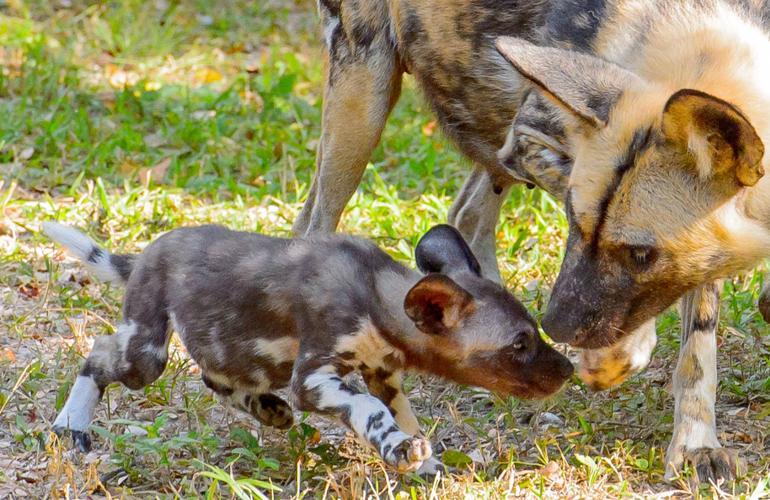
Its coat is irregularly blotched with black, white, brown, and yellowish-brown patches. Each individual has a unique pattern, making identification in the field easier for researchers. The muzzle is black, with a dark line running between the ears, bordered by pale fawn or white on the forehead. Its bushy tail is tipped in white, often raised when the pack is on the move.
Unlike other canids, African Wild Dogs have only four toes per foot instead of five.
Size:
- Total length: 105–150 cm
- Tail: 30–40 cm
- Shoulder height: 60–75 cm
- Weight: 20–30 kg

Distribution and Habitat
Historically widespread across Africa outside the equatorial forests, African Wild Dogs have suffered severe population declines due to human activity, habitat fragmentation, and persecution.
In South Africa, stable populations occur mainly in the Kruger National Park. Reintroduced populations exist in Hluhluwe–iMfolozi, Madikwe, Pilanesberg, Greater Addo, and Kwandwe reserves. Significant populations also survive in northern Mozambique’s Niassa Reserve and parts of Botswana.
They prefer open savanna and grassland habitats where visibility aids their hunting style. Dense forests and tall grasslands are generally avoided.
Behaviour and Social Structure
African Wild Dogs are highly social and live in close-knit packs, typically numbering 10–15 individuals, though pack size can vary.
They are predominantly diurnal, hunting during the cool morning and late afternoon hours. Packs move together in coordinated fashion, beginning a hunt at a steady pace before accelerating once prey begins to flee. They can reach speeds exceeding 50 km/h and maintain pursuit for several kilometres.
Once prey is singled out, the pack rarely gives up. Smaller animals are quickly pulled down, while larger prey is weakened during pursuit until it can be overpowered. Despite their fearsome hunting ability, they kill only what they need.
Their cooperation extends beyond hunting. Adults regurgitate food for pups, injured members, and those that stayed behind to guard the den. Packs are led by an alpha male and alpha female, typically the only breeding pair, though the entire pack helps raise the young.
Wild Dogs are very vocal, communicating through twittering calls, “hoo” contact calls over long distances, and various other sounds.
Home ranges are vast, averaging around 450 km² in Kruger National Park, and even larger in arid regions. They do not defend strict territories.

Diet and Feeding
African Wild Dogs hunt a wide range of prey, from small antelope such as steenbok to large species like buffalo. In Kruger National Park, impala are a primary prey species. In Botswana, springbok are particularly important.
They also prey on warthogs, nyala, rodents, hares, birds, reptiles, and occasionally insects. Remarkably, their prey can weigh two to ten times more than their own body weight.
They have one of the highest hunting success rates among large predators, often exceeding 70%.
Reproduction and Lifespan
Breeding typically occurs during the dry winter months (March to September), when hunting conditions are favourable. After a gestation period of 69–73 days, the alpha female gives birth in an abandoned burrow.
Litters usually consist of 7–10 pups, though litters of up to 15 or more have been recorded. Pups weigh around 365 grams at birth and remain near the den for the first three months.
Both males and females share in guarding and caring for the pups. Wild Dogs have 6–8 pairs of mammae to support large litters.
In the wild, African Wild Dogs live about 10–11 years, and up to 15 years in captivity.
Conservation Status
The African Wild Dog is one of Africa’s most endangered large carnivores. Habitat loss, human-wildlife conflict, road mortality, and disease from domestic dogs continue to threaten populations.
However, successful reintroduction programs and protected reserves have helped stabilize some populations in southern Africa.
Conclusion
The African Wild Dog is a symbol of teamwork, endurance, and social intelligence. With its painted coat, cooperative hunting strategies, and strong family bonds, it stands apart from other predators. Protecting this rare carnivore is essential, not only for preserving biodiversity but for maintaining the ecological balance of Africa’s wild landscapes.


- News & Current Affairs
- Business & Economy
- Finance & Money
- Education & Learning
- Technology & Innovation
- Science & Environment
- Health & Wellness
- Food & Drink
- Home, Garden & Lifestyle
- Travel & Tourism
- Fashion & Beauty
- Art & Culture
- Entertainment & Media
- Sports & Recreation
- Personal Growth & Lifestyle
- Careers & Work
- Tutorials & How-To Guides
- Real Estate & Property
- Automotive
- Family & Relationships
- Environment & Sustainability
- Law & Legal Matters
- Gaming & Esports
- Religion & Spirituality
- Community & Local Voices
- Miscellaneous
- History