


How Did Dinosaurs Look After Their Young?

For many years, scientists believed that dinosaurs simply laid their eggs in remote places and left the hatchlings to survive on their own. This idea painted dinosaurs as cold, indifferent parents. However, remarkable fossil discoveries over the past few decades have dramatically changed that view, revealing that many dinosaurs were attentive and even devoted caregivers.
Different Dinosaurs, Different Parenting Styles
Fossil evidence now shows that dinosaurs cared for their young in diverse and sophisticated ways, much like modern birds and reptiles.
A Groundbreaking Discovery in Montana
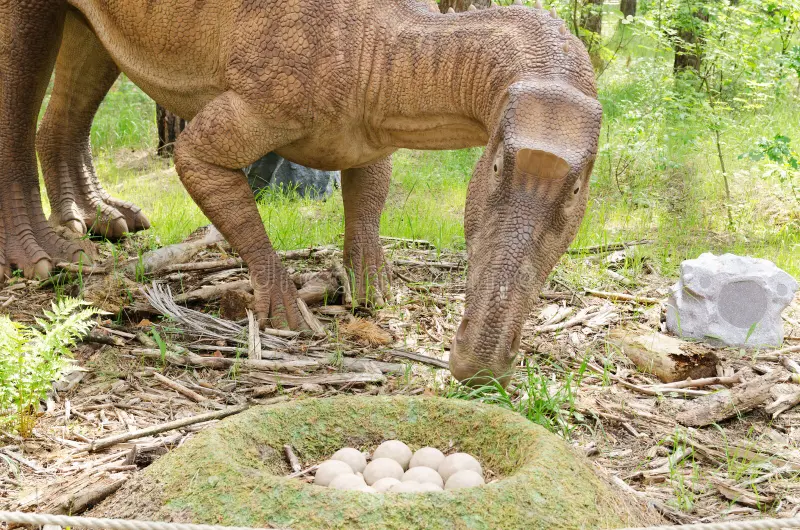
In 1978, paleontologists made a stunning discovery in Montana, USA. A large, mound-shaped nest about two metres across was uncovered, containing the remains of fifteen baby Maiasaura dinosaurs along with numerous broken eggshells. The nest was covered with vegetation, suggesting it was deliberately constructed.
What truly surprised researchers was the condition of the babies’ teeth. They were partly worn, indicating the young were not newly hatched and had been fed for some time. This strongly suggests that the adult Maiasaura returned repeatedly to the nest, bringing food to her young. The name Maiasaura fittingly means “good mother lizard.”
Nesting in the Desert: Protoceratops
Evidence of dinosaur parenting has also been found far from Montana. In the Gobi Desert, fossils of the pig-sized dinosaur Protoceratops reveal a different but equally fascinating strategy. These dinosaurs dug shallow pits in the sand and carefully buried their eggs.
The eggs were arranged in neat circular patterns, stacked in layers. Scientists believe the mother positioned herself above the nest as she laid each egg. Rather than sitting on the eggs, she relied on the natural heat of the sand to incubate them, while guarding the nest from predators until the eggs hatched.

Nesting and Incubation
Many dinosaurs built nests using vegetation and soil. Some species, such as Citipati, sat directly on their eggs to brood them.
Several Citipati fossils have been found preserved in a brooding position, with their arms spread protectively over carefully arranged eggs. This posture strongly suggests that Citipati actively guarded its nest and likely helped warm the eggs, either through direct body contact or by regulating airflow over them.
It was an attentive and protective parent, provided post-hatching care, such as remaining near the nest to protect hatchlings from predators and possibly assisting in feeding, displaying behaviour strikingly similar to those of modern birds.

Protection
Once mistakenly believed to be egg thieves, these dinosaurs fiercely guarded their nests. Fossils of oviraptorids have been found preserved atop their eggs, suggesting they stayed with their nests until death.
Their willingness to stay with the nest—even at the cost of their own lives—demonstrates a level of prolonged parental care once thought impossible for dinosaurs.
Oviraptorids stand as powerful evidence that nurturing, bird-like parenting evolved long before birds themselves took flight.

Feeding the Young
- Regurgitation: Some dinosaurs fed hatchlings partially digested food, similar to modern birds.
- Crop Milk: There is growing evidence that certain species produced a milk-like substance in their throats or stomachs, mixing it with food to nourish their young.
The “Leave-It-to-Chance” Strategy
Not all dinosaurs were hands-on parents. Some species likely laid large numbers of eggs and provided little to no care afterward, relying on sheer numbers to ensure survival.
What Fossils Tell Us
- Fossilized nests show clear signs of incubation and deliberate egg placement.
- Bonebeds containing adults and juveniles together suggest ongoing protection and feeding.
- Brooding fossils, particularly of oviraptorids, provide direct evidence of parental devotion.
Final Thoughts
Dinosaurs were far more complex and nurturing than once believed. From carefully built nests and guarded eggs to feeding and protecting their young, many dinosaurs displayed behaviour strikingly similar to modern birds. While parenting styles varied widely between species, one thing is clear: the ancient world of dinosaurs included care, protection, and family bonds, not just survival and strength.
These discoveries continue to reshape our understanding of dinosaur life, reminding us that even the most fearsome creatures could also be devoted parents.


- News & Current Affairs
- Business & Economy
- Finance & Money
- Education & Learning
- Technology & Innovation
- Science & Environment
- Health & Wellness
- Food & Drink
- Home, Garden & Lifestyle
- Travel & Tourism
- Fashion & Beauty
- Art & Culture
- Entertainment & Media
- Sports & Recreation
- Personal Growth & Lifestyle
- Careers & Work
- Tutorials & How-To Guides
- Real Estate & Property
- Automotive
- Family & Relationships
- Environment & Sustainability
- Law & Legal Matters
- Gaming & Esports
- Religion & Spirituality
- Community & Local Voices
- Miscellaneous
- History

