• Funny how life has a way of coming full circle when you least expect it.

    I’m genuinely excited to be joining the MySA platform and working alongside a team that’s not only passionate about building something meaningful, but also deeply rooted in local connection. There’s something special about a platform that understands where we come from and where we’re going.

    What makes this even more surreal is reconnecting with old school friends through this journey. Years pass, paths change, and yet here we are again—this time building, collaborating, and creating something that has the potential to bring communities closer together.

    MySA isn’t just another social network. It’s local, it’s relevant, and it’s built with purpose. I’m looking forward to what lies ahead and proud to be part of something that feels both familiar and forward-thinking at the same time.

    Here’s to new beginnings, shared history, and building something that truly matters.
    Funny how life has a way of coming full circle when you least expect it. I’m genuinely excited to be joining the MySA platform and working alongside a team that’s not only passionate about building something meaningful, but also deeply rooted in local connection. There’s something special about a platform that understands where we come from and where we’re going. What makes this even more surreal is reconnecting with old school friends through this journey. Years pass, paths change, and yet here we are again—this time building, collaborating, and creating something that has the potential to bring communities closer together. MySA isn’t just another social network. It’s local, it’s relevant, and it’s built with purpose. I’m looking forward to what lies ahead and proud to be part of something that feels both familiar and forward-thinking at the same time. Here’s to new beginnings, shared history, and building something that truly matters.
    Like
    Love
    6
    0 Comments 0 Shares 9K Views 0 Reviews
  • Today we stand together as a nation — united by our diversity, strengthened by our history, and driven by the rights that shape our future.

    Human Rights Day is not just a reminder of where we come from, but a powerful reflection of how far we’ve come. It represents freedom, dignity, equality, and the voice of every South African.

    At MySA, we believe in building a platform where every individual and every business has the opportunity to be seen, heard, and respected. Because real growth begins when people are empowered.

    Let today remind us to uplift one another, support local, and continue building a stronger South Africa — together.

    - Your voice matters
    - Your rights matter
    - Your future matters

    Happy Human Rights Day

    #HumanRightsDay #MySA #ProudlySouthAfrican #UnityInDiversity #StrongerTogether #SupportLocal
    Today we stand together as a nation — united by our diversity, strengthened by our history, and driven by the rights that shape our future. Human Rights Day is not just a reminder of where we come from, but a powerful reflection of how far we’ve come. It represents freedom, dignity, equality, and the voice of every South African. At MySA, we believe in building a platform where every individual and every business has the opportunity to be seen, heard, and respected. Because real growth begins when people are empowered. Let today remind us to uplift one another, support local, and continue building a stronger South Africa — together. - Your voice matters - Your rights matter - Your future matters Happy Human Rights Day #HumanRightsDay #MySA #ProudlySouthAfrican #UnityInDiversity #StrongerTogether #SupportLocal
    Love
    Like
    7
    0 Comments 0 Shares 27K Views 0 Reviews
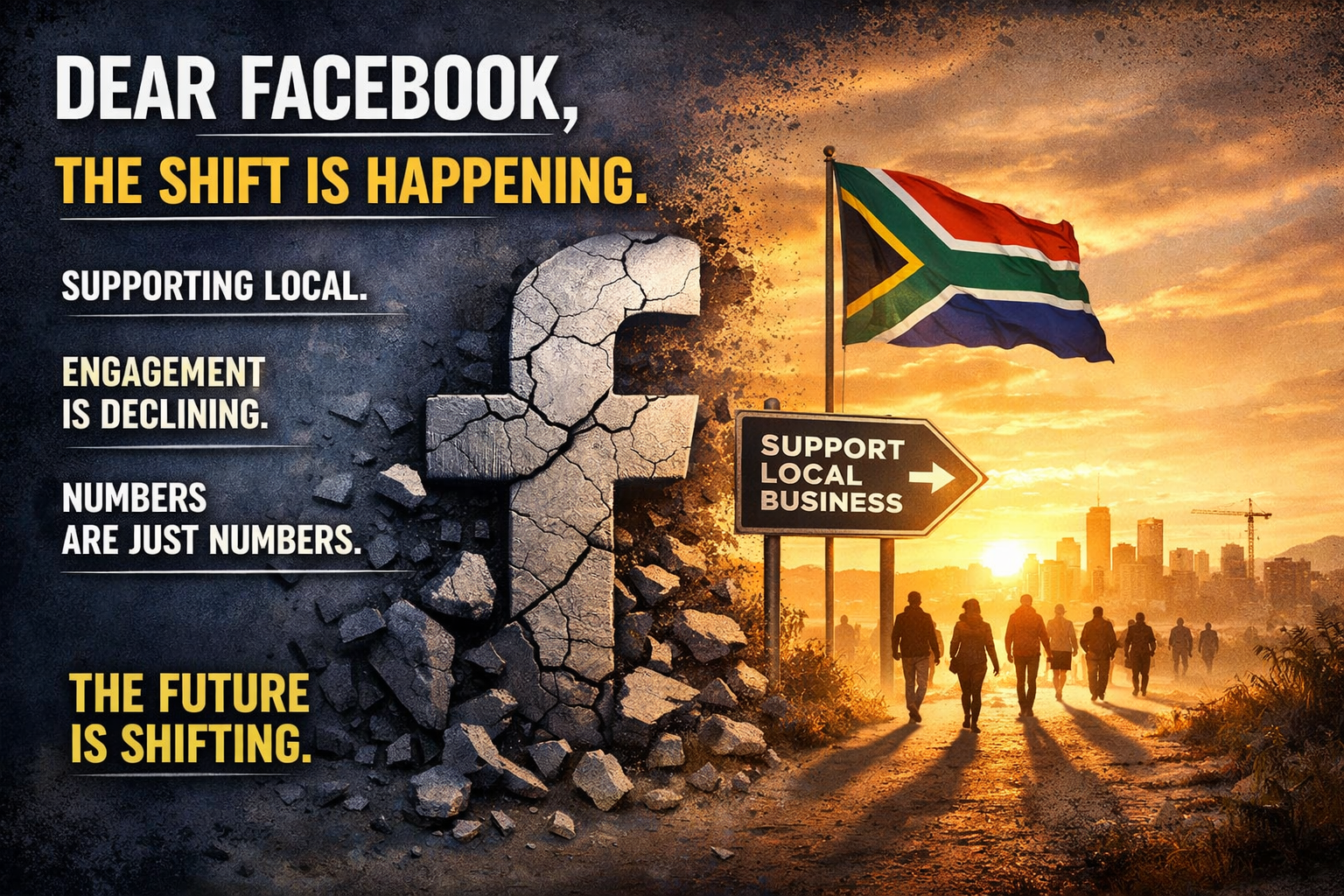
  • An Open Note to Facebook

    You can call it “AI moderation.”
    You can call it “policy enforcement.”
    You can call it whatever fits the narrative.

    But when real job opportunities are flagged and real entrepreneurs are restricted, it stops being about policy — and starts looking like fear of change.

    Because change is happening.

    Across South Africa, something is shifting. Quietly. Steadily. Intentionally.

    People are becoming more conscious about where they spend their time, their money, and their attention. Businesses are starting to question what thousands of “followers” really mean when fewer than 10% are active. When engagement drops. When visibility declines. When pages with years of history feel like empty halls.

    Numbers without interaction are just numbers.
    Followers without reach are just decoration.
    Presence without impact is just illusion.

    The reality is this: markets evolve.
    Communities shift.
    And people move toward platforms that value real opportunity and real connection.

    You may still have the big numbers.
    But the momentum is changing.

    South Africans are thinking differently.
    Supporting differently.
    Building differently.

    And step by step, the landscape is adjusting.

    This isn’t anger.
    It’s observation.

    And the shift has already begun.

    #ImpactSA #MySA
    An Open Note to Facebook You can call it “AI moderation.” You can call it “policy enforcement.” You can call it whatever fits the narrative. But when real job opportunities are flagged and real entrepreneurs are restricted, it stops being about policy — and starts looking like fear of change. Because change is happening. Across South Africa, something is shifting. Quietly. Steadily. Intentionally. People are becoming more conscious about where they spend their time, their money, and their attention. Businesses are starting to question what thousands of “followers” really mean when fewer than 10% are active. When engagement drops. When visibility declines. When pages with years of history feel like empty halls. Numbers without interaction are just numbers. Followers without reach are just decoration. Presence without impact is just illusion. The reality is this: markets evolve. Communities shift. And people move toward platforms that value real opportunity and real connection. You may still have the big numbers. But the momentum is changing. South Africans are thinking differently. Supporting differently. Building differently. And step by step, the landscape is adjusting. This isn’t anger. It’s observation. And the shift has already begun. #ImpactSA #MySA
    Love
    Like
    5
    0 Comments 0 Shares 21K Views 0 Reviews
  • Did you Know?

    The sharpest teeth in history didn’t belong to sharks or even dinosaurs.

    They came from conodonts ancient, eel-like creatures lived about 500–200 million years ago.
    Did you Know? The sharpest teeth in history didn’t belong to sharks or even dinosaurs. They came from conodonts ancient, eel-like creatures lived about 500–200 million years ago.
    Like
    8
    0 Comments 0 Shares 4K Views 0 Reviews
  • A Crime Short Story by The Cozy Nook Writer:

    Patterns Don’t Lie:

    Detective Robert Hale had learned to trust patterns more than people.

    People lied, forgot, changed their stories. Patterns stayed loyal to themselves.

    The latest crime scene looked ordinary at first glance: a small second-floor apartment, furniture overturned just enough to suggest a struggle, drawers pulled out but not fully emptied. Officers moved around quietly, taking photos, bagging evidence. Someone muttered that it was probably another robbery gone wrong.

    Robert didn’t answer. He was staring at the clock on the wall.

    It had stopped at 2:17 a.m.

    “Why would a thief stop a clock?” he asked.

    No one had an answer.

    On his way out, Robert noticed the window cracked open, rainwater seeping onto the sill. It bothered him more than it should have. That night, at home, he dug through the department’s digital archives, following a feeling he couldn’t quite explain.

    He found it an hour later.

    An unsolved case from 1989. Same stopped clock. Same time. Same open window.

    The next morning, Robert requested the old file from storage. Then another. And another. Soon his office was stacked with boxes labeled *Unresolved*. Each one told a story that had never ended—murders with no arrests, suspects who vanished, evidence that led nowhere.

    Individually, they were cold. Together, they were speaking.

    A victim left near a riverbank in 1974. Another found the same way last year. A pawn shop receipt in two different cities, decades apart. A cheap wristwatch placed beside the body instead of worn. Always small details. Always things most detectives would ignore.

    Robert pinned photos and notes across a corkboard. Red string crisscrossed the surface like a web.

    “This isn’t coincidence,” he said to himself.

    The killer wasn’t just inspired by the past. They were following it. Carefully. Respectfully. Almost lovingly.

    Robert started reading the old cases differently. Not as investigations, but as instructions.

    In one case, the police had focused too hard on a neighbor who owned a similar jacket to one seen near the scene. In another, they wasted months chasing a witness who later admitted to lying. Each mistake, each wrong turn, was preserved in the files.

    And the modern crimes repeated those same mistakes perfectly.

    The killer knew exactly how to disappear.

    Until they didn’t.

    The break came from a forgotten detail Robert remembered reading years ago, back when he was still a rookie: a handwritten note left at an old crime scene. The public version mentioned the message but not the wording. Internally, the note was famous for one thing—the writer had misspelled a simple word.

    Robert pulled the file again and compared it to a photo from the latest crime scene.

    Same word. Same misspelling.

    “That detail was never released,” Robert whispered.

    Only two kinds of people could know it: the original killer… or someone who had studied the case files.

    Robert made a new list. Not suspects—readers.

    He tracked down everyone who had accessed multiple unsolved case files over the years: retired officers, archivists, crime bloggers, researchers. One name kept appearing, quietly, consistently, across decades.

    Adam Mercer.

    Mercer wasn’t a cop. He was a clerk. A background worker who moved boxes, digitized reports, organized evidence. Invisible by design. He had spent years surrounded by stories that never reached an ending.

    Robery visited Mercer’s apartment with a warrant.

    Inside, the walls were covered floor to ceiling with clippings, photos, and handwritten notes. Each unsolved case had its own section, neatly arranged. Some were crossed out. Others were marked *Incomplete*.

    One space on the wall was empty.

    Robert turned to Mercer, who stood calmly by the table.

    “You were fixing them,” Robert said. “In your own way.”

    Mercer smiled faintly. “I was finishing what they started. The system failed them. I didn’t.”
    Robert shook his head. “You didn’t fix anything. You just copied history and hoped we’d repeat our mistakes.”

    Mercer’s smile faded.

    “But you didn’t,” he said.

    “No,” Robert replied. “You did.”

    The case closed quietly. No dramatic press conference. No headlines celebrating the detective who cracked it. Just another solved file placed gently back into storage.
    Robert returned to his office late that night and took down the corkboard. As he packed the old files away, he paused, running his hand over the worn cardboard.

    Unsolved cases, he realized, were never really forgotten.

    Someone was always reading them.

    A Crime Short Story by The Cozy Nook Writer: Patterns Don’t Lie: Detective Robert Hale had learned to trust patterns more than people. People lied, forgot, changed their stories. Patterns stayed loyal to themselves. The latest crime scene looked ordinary at first glance: a small second-floor apartment, furniture overturned just enough to suggest a struggle, drawers pulled out but not fully emptied. Officers moved around quietly, taking photos, bagging evidence. Someone muttered that it was probably another robbery gone wrong. Robert didn’t answer. He was staring at the clock on the wall. It had stopped at 2:17 a.m. “Why would a thief stop a clock?” he asked. No one had an answer. On his way out, Robert noticed the window cracked open, rainwater seeping onto the sill. It bothered him more than it should have. That night, at home, he dug through the department’s digital archives, following a feeling he couldn’t quite explain. He found it an hour later. An unsolved case from 1989. Same stopped clock. Same time. Same open window. The next morning, Robert requested the old file from storage. Then another. And another. Soon his office was stacked with boxes labeled *Unresolved*. Each one told a story that had never ended—murders with no arrests, suspects who vanished, evidence that led nowhere. Individually, they were cold. Together, they were speaking. A victim left near a riverbank in 1974. Another found the same way last year. A pawn shop receipt in two different cities, decades apart. A cheap wristwatch placed beside the body instead of worn. Always small details. Always things most detectives would ignore. Robert pinned photos and notes across a corkboard. Red string crisscrossed the surface like a web. “This isn’t coincidence,” he said to himself. The killer wasn’t just inspired by the past. They were following it. Carefully. Respectfully. Almost lovingly. Robert started reading the old cases differently. Not as investigations, but as instructions. In one case, the police had focused too hard on a neighbor who owned a similar jacket to one seen near the scene. In another, they wasted months chasing a witness who later admitted to lying. Each mistake, each wrong turn, was preserved in the files. And the modern crimes repeated those same mistakes perfectly. The killer knew exactly how to disappear. Until they didn’t. The break came from a forgotten detail Robert remembered reading years ago, back when he was still a rookie: a handwritten note left at an old crime scene. The public version mentioned the message but not the wording. Internally, the note was famous for one thing—the writer had misspelled a simple word. Robert pulled the file again and compared it to a photo from the latest crime scene. Same word. Same misspelling. “That detail was never released,” Robert whispered. Only two kinds of people could know it: the original killer… or someone who had studied the case files. Robert made a new list. Not suspects—readers. He tracked down everyone who had accessed multiple unsolved case files over the years: retired officers, archivists, crime bloggers, researchers. One name kept appearing, quietly, consistently, across decades. Adam Mercer. Mercer wasn’t a cop. He was a clerk. A background worker who moved boxes, digitized reports, organized evidence. Invisible by design. He had spent years surrounded by stories that never reached an ending. Robery visited Mercer’s apartment with a warrant. Inside, the walls were covered floor to ceiling with clippings, photos, and handwritten notes. Each unsolved case had its own section, neatly arranged. Some were crossed out. Others were marked *Incomplete*. One space on the wall was empty. Robert turned to Mercer, who stood calmly by the table. “You were fixing them,” Robert said. “In your own way.” Mercer smiled faintly. “I was finishing what they started. The system failed them. I didn’t.” Robert shook his head. “You didn’t fix anything. You just copied history and hoped we’d repeat our mistakes.” Mercer’s smile faded. “But you didn’t,” he said. “No,” Robert replied. “You did.” The case closed quietly. No dramatic press conference. No headlines celebrating the detective who cracked it. Just another solved file placed gently back into storage. Robert returned to his office late that night and took down the corkboard. As he packed the old files away, he paused, running his hand over the worn cardboard. Unsolved cases, he realized, were never really forgotten. Someone was always reading them.

    Love
    1
    0 Comments 1 Shares 7K Views 0 Reviews
  • https://youtu.be/lblThWs9FWc

    A Brief History of Gold
    https://youtu.be/lblThWs9FWc A Brief History of Gold
    Love
    Like
    8
    0 Comments 0 Shares 4K Views 0 Reviews
  • A Crime Short Story by The Cozy Nook Writer:


    The Wrong Suspect:


    Everyone in Larkspur Hollow knew who had done it.
    They said it was Jake Parker—quiet, sharp-eyed Jake who lived alone by the quarry and never came to town meetings. When the body of Mayor Eli was found at the base of the courthouse steps, Jake’s name passed from mouth to mouth like a fact instead of a guess.
    “He argued with the mayor last week,” people whispered.
    “He’s always lurking,” they said.
    “He had a reason.”
    By the time the sheriff arrived, suspicion had already settled like dust.
    Detective Mia Robertson came in from the city that evening, coat damp from the rain, notebook already open. She listened carefully as people told her what they knew. She asked calm questions, nodded at the right moments, and never contradicted anyone directly.
    Jake was brought in the next morning. He looked more tired than angry.
    “I didn’t do it,” he said, again and again. “I was at the quarry. Fixing the pump.”
    Mia checked the quarry. The pump had been fixed. Recently. She wrote that down.
    She spent the next two days walking the town with Sheriff Smith, asking about Mayor Eli’s last hours. Every trail seemed to bend back toward Jake, like the town itself was steering her there. Even the evidence felt convenient: a torn sleeve, footprints near the courthouse, a long history of arguments.
    Still, something bothered her.
    Mayor Eli had been pushed—hard—but there were no signs of a struggle. No scattered papers. No knocked-over planters. Whoever did it hadn’t been surprised.
    And then there was Deputy Andrew Cole.
    Andrew was everywhere. He fetched files before she asked. He knew which witnesses would “help” and which ones to avoid. He spoke gently about Jake, almost sadly, as if the matter were already settled.
    “He’s a troubled guy,” Andrew said one night as they reviewed notes. “Town’s safer without him.”
    Mia looked up. “You’ve known Jake a long time?”
    Andrew nodded. “Long enough.”
    Too long, she thought. And too smooth.
    She checked the courthouse security logs. The cameras had gone out that night—unusual, but not unheard of. The maintenance report was signed by Andrew Cole.
    She didn’t say anything. Not yet.
    Instead, she went back to the quarry at dusk and found Jake again. He showed her the pump, the grease still fresh under his nails. He told her about the mayor threatening to sell the land to a developer—and about Andrew’s brother, who’d lost his job when the deal fell through.
    “That’s when Andrew stopped talking to me,” Jake said quietly. “That’s when he started talking about me.”
    Mia returned to the station and asked Andrew to walk her through the timeline one more time. He did, confidently. Too confidently.
    When she asked why his boots matched the footprint pattern near the courthouse, he smiled and said, “Small town. Same brand.”
    When she asked why his key card had accessed the camera room after hours, his smile slipped.
    The room went quiet.
    Andrew’s hand twitched toward the desk drawer, then stilled when the sheriff stepped forward.
    “I was just helping,” Andrew said. “Someone had to keep things moving.”
    Mia closed her notebook. “You did. Right where you wanted them.”
    Jake was released that night. The town was slower to change its mind, but truth has a way of staying put.
    As Mia drove out of Larkspur Hollow, she glanced in the mirror at the quiet streets.
    The most dangerous suspects, she thought, are the ones everyone trusts to help.
    A Crime Short Story by The Cozy Nook Writer: The Wrong Suspect: Everyone in Larkspur Hollow knew who had done it. They said it was Jake Parker—quiet, sharp-eyed Jake who lived alone by the quarry and never came to town meetings. When the body of Mayor Eli was found at the base of the courthouse steps, Jake’s name passed from mouth to mouth like a fact instead of a guess. “He argued with the mayor last week,” people whispered. “He’s always lurking,” they said. “He had a reason.” By the time the sheriff arrived, suspicion had already settled like dust. Detective Mia Robertson came in from the city that evening, coat damp from the rain, notebook already open. She listened carefully as people told her what they knew. She asked calm questions, nodded at the right moments, and never contradicted anyone directly. Jake was brought in the next morning. He looked more tired than angry. “I didn’t do it,” he said, again and again. “I was at the quarry. Fixing the pump.” Mia checked the quarry. The pump had been fixed. Recently. She wrote that down. She spent the next two days walking the town with Sheriff Smith, asking about Mayor Eli’s last hours. Every trail seemed to bend back toward Jake, like the town itself was steering her there. Even the evidence felt convenient: a torn sleeve, footprints near the courthouse, a long history of arguments. Still, something bothered her. Mayor Eli had been pushed—hard—but there were no signs of a struggle. No scattered papers. No knocked-over planters. Whoever did it hadn’t been surprised. And then there was Deputy Andrew Cole. Andrew was everywhere. He fetched files before she asked. He knew which witnesses would “help” and which ones to avoid. He spoke gently about Jake, almost sadly, as if the matter were already settled. “He’s a troubled guy,” Andrew said one night as they reviewed notes. “Town’s safer without him.” Mia looked up. “You’ve known Jake a long time?” Andrew nodded. “Long enough.” Too long, she thought. And too smooth. She checked the courthouse security logs. The cameras had gone out that night—unusual, but not unheard of. The maintenance report was signed by Andrew Cole. She didn’t say anything. Not yet. Instead, she went back to the quarry at dusk and found Jake again. He showed her the pump, the grease still fresh under his nails. He told her about the mayor threatening to sell the land to a developer—and about Andrew’s brother, who’d lost his job when the deal fell through. “That’s when Andrew stopped talking to me,” Jake said quietly. “That’s when he started talking about me.” Mia returned to the station and asked Andrew to walk her through the timeline one more time. He did, confidently. Too confidently. When she asked why his boots matched the footprint pattern near the courthouse, he smiled and said, “Small town. Same brand.” When she asked why his key card had accessed the camera room after hours, his smile slipped. The room went quiet. Andrew’s hand twitched toward the desk drawer, then stilled when the sheriff stepped forward. “I was just helping,” Andrew said. “Someone had to keep things moving.” Mia closed her notebook. “You did. Right where you wanted them.” Jake was released that night. The town was slower to change its mind, but truth has a way of staying put. As Mia drove out of Larkspur Hollow, she glanced in the mirror at the quiet streets. The most dangerous suspects, she thought, are the ones everyone trusts to help.
    Like
    Love
    6
    0 Comments 0 Shares 6K Views 0 Reviews
  • As with all growing enterprises, there are seasons we move through—each bringing its own challenges, lessons, and opportunities.

    Today, we want to take a moment to sincerely thank every individual who takes the time to log into their account, stay active, and be part of this growing community.

    Your support, your commitment, and your willingness to be part of something bigger truly matter. By simply being here, engaging, and showing up, you are already helping others and contributing to something meaningful. For that, we are genuinely grateful.

    And now, just like the seasons of life, we are moving into a new season.

    This next phase brings exciting new discoveries, new ways to interact, and new opportunities for you to be showcased and recognized. It is a season of growth, energy, and joy—and we are incredibly proud to have you as part of it.

    More news and information will be shared in the coming days. As we unveil what’s ahead, we hope you’re ready, because what’s coming is something truly special—something that will go down in history in a uniquely powerful way.

    Thank you for being part of the journey.

    #MySA
    As with all growing enterprises, there are seasons we move through—each bringing its own challenges, lessons, and opportunities. Today, we want to take a moment to sincerely thank every individual who takes the time to log into their account, stay active, and be part of this growing community. Your support, your commitment, and your willingness to be part of something bigger truly matter. By simply being here, engaging, and showing up, you are already helping others and contributing to something meaningful. For that, we are genuinely grateful. And now, just like the seasons of life, we are moving into a new season. This next phase brings exciting new discoveries, new ways to interact, and new opportunities for you to be showcased and recognized. It is a season of growth, energy, and joy—and we are incredibly proud to have you as part of it. More news and information will be shared in the coming days. As we unveil what’s ahead, we hope you’re ready, because what’s coming is something truly special—something that will go down in history in a uniquely powerful way. Thank you for being part of the journey. #MySA
    Love
    Like
    17
    1 Comments 0 Shares 4K Views 0 Reviews
  • Just when everyone thought the Netflix and Warner Bros deal was basically sealed, Paramount Skydance has exploded into the scene with one of the boldest moves in entertainment history.

    Paramount did not whisper. They did not negotiate quietly.
    They arrived with a hostile all cash offer and they arrived loudly.

    They are offering Warner Bros Discovery shareholders $108 Billion, more money upfront than Netflix and they are telling the entire industry that their plan is cleaner, simpler and stronger. No complicated stock mix. No corporate split. Just straight cash for full control of the company.

    If Paramount wins this battle, the entire landscape of film, TV, sports, animation and streaming changes overnight. Imagine combining Paramount’s legendary catalogue with the massive Warner Bros library. That is decades of blockbuster franchises, studios, channels and global brands joining forces under one giant studio.

    This is not business as usual. This is a fight for the soul of entertainment.

    Netflix wants the future.
    Paramount wants the throne.
    Warner Bros is the crown.

    Just when everyone thought the Netflix and Warner Bros deal was basically sealed, Paramount Skydance has exploded into the scene with one of the boldest moves in entertainment history. Paramount did not whisper. They did not negotiate quietly. They arrived with a hostile all cash offer and they arrived loudly. They are offering Warner Bros Discovery shareholders $108 Billion, more money upfront than Netflix and they are telling the entire industry that their plan is cleaner, simpler and stronger. No complicated stock mix. No corporate split. Just straight cash for full control of the company. If Paramount wins this battle, the entire landscape of film, TV, sports, animation and streaming changes overnight. Imagine combining Paramount’s legendary catalogue with the massive Warner Bros library. That is decades of blockbuster franchises, studios, channels and global brands joining forces under one giant studio. This is not business as usual. This is a fight for the soul of entertainment. Netflix wants the future. Paramount wants the throne. Warner Bros is the crown. 👑
    Like
    Haha
    9
    0 Comments 0 Shares 7K Views 0 Reviews
  • How Did The Olympic Games Begin?


    The Olympic Games actually began in ancient Greece nearly 3,000 years ago, and they weren’t just about sport at first — they were part of a religious festival dedicated to Zeus.

    The earliest recorded Olympics took place in 776 BC at Olympia, and the entire event consisted of just one race: a short sprint called the stade. A cook named Koroibos of Elis won it, making him the first known Olympic champion.

    Over time, the Games grew massively. What started as a simple footrace expanded to include wrestling, boxing, chariot racing, discus, javelin, and long-distance running. By the 5th century BC, athletes from nearly 100 Greek cities were competing.

    The Games were so important that Greeks used the four-year interval between them — an Olympiad — as a way to track time.

    But eventually, with the rise of Rome, the Olympics began to fade. In 393 AD, Emperor Theodosius I — a Christian ruler — banned the Games altogether as part of his effort to end pagan traditions. After that, the Olympics disappeared for over 1,500 years.


    The Modern Revival

    Fast forward to the 19th century, when fascination with ancient Greek culture returned during the Renaissance and Enlightenment. There were a few small “Olympic-like” festivals in Europe, but nothing official — until a young French baron, Pierre de Coubertin, came up with a bold idea.

    In 1892, he proposed bringing the Olympics back as a global sporting event meant to promote peace and unity. Two years later, at a sports conference in Paris, his vision was approved, and the International Olympic Committee (IOC) was created.

    The first modern Olympic Games took place in Athens in 1896, a full circle moment for history. There were 280 athletes from 13 nations, competing in 43 events, mostly in track-and-field, swimming, cycling, wrestling, gymnastics, and more. All the athletes were men — and amusingly, a few were tourists who simply signed up on the spot.

    This edition of the Olympics also featured the first modern marathon, inspired by the legendary run from Marathon to Athens by a Greek messenger in 490 BC. Fittingly, a Greek athlete, Spyridon Louis, won it.


    Growth Into the Global Event We Know Today

    Pierre de Coubertin became IOC president and guided the young Games through tough early years. The breakthrough came with the 1924 Olympics in Paris, which had more than 3,000 athletes — including over 100 women — from 44 nations. That year also saw the launch of the Winter Olympics.

    Coubertin retired the following year, but his vision lived on. The Olympics eventually became the world’s biggest international sports competition.

    When the Games returned to Athens in 2004, more than 11,000 athletes from 202 countries took part. The shot put even took place at ancient Olympia, linking past and present in a powerful way.
    How Did The Olympic Games Begin? The Olympic Games actually began in ancient Greece nearly 3,000 years ago, and they weren’t just about sport at first — they were part of a religious festival dedicated to Zeus. The earliest recorded Olympics took place in 776 BC at Olympia, and the entire event consisted of just one race: a short sprint called the stade. A cook named Koroibos of Elis won it, making him the first known Olympic champion. Over time, the Games grew massively. What started as a simple footrace expanded to include wrestling, boxing, chariot racing, discus, javelin, and long-distance running. By the 5th century BC, athletes from nearly 100 Greek cities were competing. The Games were so important that Greeks used the four-year interval between them — an Olympiad — as a way to track time. But eventually, with the rise of Rome, the Olympics began to fade. In 393 AD, Emperor Theodosius I — a Christian ruler — banned the Games altogether as part of his effort to end pagan traditions. After that, the Olympics disappeared for over 1,500 years. The Modern Revival Fast forward to the 19th century, when fascination with ancient Greek culture returned during the Renaissance and Enlightenment. There were a few small “Olympic-like” festivals in Europe, but nothing official — until a young French baron, Pierre de Coubertin, came up with a bold idea. In 1892, he proposed bringing the Olympics back as a global sporting event meant to promote peace and unity. Two years later, at a sports conference in Paris, his vision was approved, and the International Olympic Committee (IOC) was created. The first modern Olympic Games took place in Athens in 1896, a full circle moment for history. There were 280 athletes from 13 nations, competing in 43 events, mostly in track-and-field, swimming, cycling, wrestling, gymnastics, and more. All the athletes were men — and amusingly, a few were tourists who simply signed up on the spot. This edition of the Olympics also featured the first modern marathon, inspired by the legendary run from Marathon to Athens by a Greek messenger in 490 BC. Fittingly, a Greek athlete, Spyridon Louis, won it. Growth Into the Global Event We Know Today Pierre de Coubertin became IOC president and guided the young Games through tough early years. The breakthrough came with the 1924 Olympics in Paris, which had more than 3,000 athletes — including over 100 women — from 44 nations. That year also saw the launch of the Winter Olympics. Coubertin retired the following year, but his vision lived on. The Olympics eventually became the world’s biggest international sports competition. When the Games returned to Athens in 2004, more than 11,000 athletes from 202 countries took part. The shot put even took place at ancient Olympia, linking past and present in a powerful way.
    Like
    Love
    8
    0 Comments 0 Shares 16K Views 0 Reviews
More Results
MySA - South Africa https://mysa.social