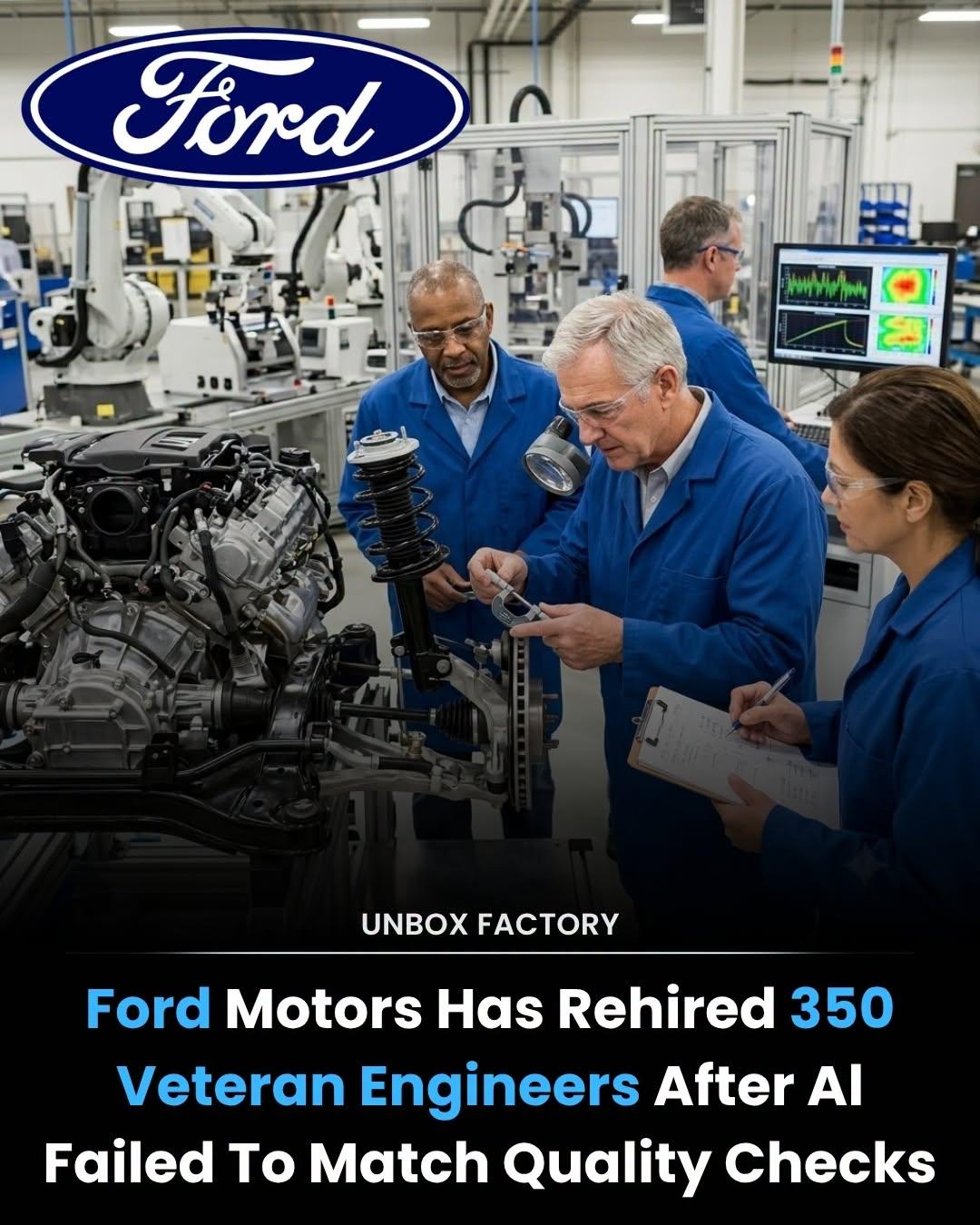

• Ford has reportedly brought back more than 350 experienced engineers after AI-assisted quality control systems struggled to consistently detect manufacturing defects and production inconsistencies on assembly lines.


    While artificial intelligence remains valuable for automating repetitive inspections and analyzing massive amounts of production data, Ford concluded that experienced human engineers still outperform AI in identifying subtle fit, finish, and reliability issues that directly affect vehicle quality. The move highlights the continuing importance of combining AI with human expertise rather than replacing skilled workers entirely.


    Source: Industry Reports, 2026


    #Ford #ArtificialIntelligence #Manufacturing #Engineering
    Ford has reportedly brought back more than 350 experienced engineers after AI-assisted quality control systems struggled to consistently detect manufacturing defects and production inconsistencies on assembly lines. While artificial intelligence remains valuable for automating repetitive inspections and analyzing massive amounts of production data, Ford concluded that experienced human engineers still outperform AI in identifying subtle fit, finish, and reliability issues that directly affect vehicle quality. The move highlights the continuing importance of combining AI with human expertise rather than replacing skilled workers entirely. Source: Industry Reports, 2026 #Ford #ArtificialIntelligence #Manufacturing #Engineering
    0 Comments 0 Shares 257 Views 0 Reviews
  • The Market Has Enough AI That Can Talk. Notelon Was Built to Think.


    A new generation of artificial intelligence is about to be introduced.


    Notelon is not being created to become another chatbot with polished answers, recycled knowledge and an impressive-looking interface. It is being engineered as a practical intelligence system capable of understanding complex challenges, connecting information, solving real-world problems and producing outcomes that matter.


    The public will soon be given access to Notelon, but what they experience will only be the beginning.


    Its true power lies behind the reason it was created: to serve as the intelligent core behind our platforms, technologies and future systems. Its knowledge architecture is being shaped around the practical reasoning, technical experience and decision-making framework of the most advanced applied mind within our organisation.


    Not just theoretical intelligence.


    Not intelligence built to sound clever.


    Practical intelligence—built by people who understand how things actually work.


    Notelon is being developed to analyse deeper, adapt faster and operate with the kind of real-world understanding that cannot simply be copied from a textbook, scraped from the internet or created through clever prompting.


    Some AI systems are designed to follow the future.


    Notelon is being built to help create it.


    Notelon Beta V1.0 will be released to the public in the coming days.


    The next generation is almost here.


    Powered by Tome Tech. Built to think beyond the obvious.


    #Notelon #TomeTech #ArtificialIntelligence #NextGenerationAI #AIInnovation #SoftwareEngineering #TechnologyDevelopment #BuiltForTheRealWorld #TheFutureIsComing
    The Market Has Enough AI That Can Talk. Notelon Was Built to Think. A new generation of artificial intelligence is about to be introduced. Notelon is not being created to become another chatbot with polished answers, recycled knowledge and an impressive-looking interface. It is being engineered as a practical intelligence system capable of understanding complex challenges, connecting information, solving real-world problems and producing outcomes that matter. The public will soon be given access to Notelon, but what they experience will only be the beginning. Its true power lies behind the reason it was created: to serve as the intelligent core behind our platforms, technologies and future systems. Its knowledge architecture is being shaped around the practical reasoning, technical experience and decision-making framework of the most advanced applied mind within our organisation. Not just theoretical intelligence. Not intelligence built to sound clever. Practical intelligence—built by people who understand how things actually work. Notelon is being developed to analyse deeper, adapt faster and operate with the kind of real-world understanding that cannot simply be copied from a textbook, scraped from the internet or created through clever prompting. Some AI systems are designed to follow the future. Notelon is being built to help create it. Notelon Beta V1.0 will be released to the public in the coming days. The next generation is almost here. Powered by Tome Tech. Built to think beyond the obvious. #Notelon #TomeTech #ArtificialIntelligence #NextGenerationAI #AIInnovation #SoftwareEngineering #TechnologyDevelopment #BuiltForTheRealWorld #TheFutureIsComing
    Like
    Love
    21
    2 Comments 2 Shares 9K Views 0 Reviews
  • TRANSFORMATION IS NOT A RACE. IT IS A STRATEGIC JOURNEY.


    The greatest distance is not always covered by moving the fastest. It is often achieved by taking small, deliberate steps—consistently, strategically and with a clear purpose.


    While some companies rush from Point A to Point B without paying attention to what happens between them, we choose a different path.


    At Tome Technologies, we strive to build better.


    We do not rush simply to appear ahead. We focus on getting the important things right. We study every stage, test every component, solve the hidden problems and strengthen the foundation before moving forward.


    Because what happens between Point A and Point B determines whether you are truly prepared for Point C—and every stage that follows.


    That is how a business evolves.


    That is how systems are upgraded.


    That is how you enter a market prepared to compete, adapt and outperform.


    We do not need to become the next Scorpion Computer Services, nor do we need to prove that we are the next Meta development team. We are not interested in borrowing someone else’s identity or building our reputation through exaggerated claims.


    Our work speaks for itself.


    Today, too many people call themselves developers simply because they can use an artificial intelligence tool to generate code. However, generating code and understanding software engineering are two very different things.


    A genuine developer must be able to understand the architecture, assemble the components, identify faults, resolve failures, improve performance, expand functionality and maintain the system long after the first line of code has been written.


    When the AI tool is no longer there to provide the next answer, the developer must still understand the system.


    Coding is not a game.


    Software engineering is a professional industry that demands knowledge, discipline, experience, problem-solving ability and accountability. It requires more than hype, attractive terminology or copied code.


    We have no need to declare that we are the best. The platforms, systems and environments we build will allow people to form their own conclusions.


    Over the next 21 days, we have set an internal target to finalise and showcase several of the most advanced industry-specific digital environments we have developed.


    We are not doing this to prove a point.


    We are simply beginning to reveal more of what we have been doing behind the scenes—work that most people have never had the opportunity to see.


    There will always be projects we cannot publicly disclose. Some of the largest platforms and systems people interact with may contain technology, architecture or code developed quietly in the background.


    You do not always need to know where every line of code originated to experience the value it delivers.


    There are, however, major systems carrying the unmistakable Tome Technologies development signature that we are now ready to share.


    We are preparing to make waves within several industries.


    We are preparing to show certain industry giants that the vision discussed behind closed boardroom doors was never simply an idea. It was a strategic plan—and that plan is now becoming a reality.


    The most exciting part is that the journey has only just begun.


    Watch closely.


    Enjoy the transformation.


    Pay attention to every improvement, every upgrade and every strategic step, because each change tells part of a much greater story.


    Something that has been standing in plain sight is about to evolve into an advanced, next-generation industry giant.


    Follow Tome Technologies, stay informed and become part of the journey.


    The individual changes may appear small—but when they are brought together, they will paint the complete picture.


    Get ready. The next chapter starts now.


    #TomeTechnologies #SoftwareEngineering #DigitalTransformation #TechnologyInnovation #BusinessEvolution #StrategicGrowth #CustomSoftware #PlatformDevelopment #FutureOfTechnology #BuiltNotCopied #InnovationInAction #TheJourneyBegins
    TRANSFORMATION IS NOT A RACE. IT IS A STRATEGIC JOURNEY. The greatest distance is not always covered by moving the fastest. It is often achieved by taking small, deliberate steps—consistently, strategically and with a clear purpose. While some companies rush from Point A to Point B without paying attention to what happens between them, we choose a different path. At Tome Technologies, we strive to build better. We do not rush simply to appear ahead. We focus on getting the important things right. We study every stage, test every component, solve the hidden problems and strengthen the foundation before moving forward. Because what happens between Point A and Point B determines whether you are truly prepared for Point C—and every stage that follows. That is how a business evolves. That is how systems are upgraded. That is how you enter a market prepared to compete, adapt and outperform. We do not need to become the next Scorpion Computer Services, nor do we need to prove that we are the next Meta development team. We are not interested in borrowing someone else’s identity or building our reputation through exaggerated claims. Our work speaks for itself. Today, too many people call themselves developers simply because they can use an artificial intelligence tool to generate code. However, generating code and understanding software engineering are two very different things. A genuine developer must be able to understand the architecture, assemble the components, identify faults, resolve failures, improve performance, expand functionality and maintain the system long after the first line of code has been written. When the AI tool is no longer there to provide the next answer, the developer must still understand the system. Coding is not a game. Software engineering is a professional industry that demands knowledge, discipline, experience, problem-solving ability and accountability. It requires more than hype, attractive terminology or copied code. We have no need to declare that we are the best. The platforms, systems and environments we build will allow people to form their own conclusions. Over the next 21 days, we have set an internal target to finalise and showcase several of the most advanced industry-specific digital environments we have developed. We are not doing this to prove a point. We are simply beginning to reveal more of what we have been doing behind the scenes—work that most people have never had the opportunity to see. There will always be projects we cannot publicly disclose. Some of the largest platforms and systems people interact with may contain technology, architecture or code developed quietly in the background. You do not always need to know where every line of code originated to experience the value it delivers. There are, however, major systems carrying the unmistakable Tome Technologies development signature that we are now ready to share. We are preparing to make waves within several industries. We are preparing to show certain industry giants that the vision discussed behind closed boardroom doors was never simply an idea. It was a strategic plan—and that plan is now becoming a reality. The most exciting part is that the journey has only just begun. Watch closely. Enjoy the transformation. Pay attention to every improvement, every upgrade and every strategic step, because each change tells part of a much greater story. Something that has been standing in plain sight is about to evolve into an advanced, next-generation industry giant. Follow Tome Technologies, stay informed and become part of the journey. The individual changes may appear small—but when they are brought together, they will paint the complete picture. Get ready. The next chapter starts now. #TomeTechnologies #SoftwareEngineering #DigitalTransformation #TechnologyInnovation #BusinessEvolution #StrategicGrowth #CustomSoftware #PlatformDevelopment #FutureOfTechnology #BuiltNotCopied #InnovationInAction #TheJourneyBegins
    Like
    Love
    2
    0 Comments 0 Shares 5K Views 0 Reviews
  • Behind the Scenes at Mysatech :-

    What you’re seeing here is just a glimpse.

    Behind the scenes, Mysatech has been undergoing a full-scale transformation — not simply a website upgrade, but a complete re-engineering of how our digital ecosystem works, looks, and connects.

    When the final upgraded Mysatech website goes live this Monday, it won’t be something you simply scroll through.
    It will be something you explore.

    Every page has been designed as part of a broader journey — where each click reveals something new, each section tells a story, and every interaction uncovers another layer of what Mysatech is building behind the scenes.

    From powerful new platforms and verified systems to deeper integrations across our ecosystem, this launch marks the beginning of a far more immersive digital experience.

    This screenshot is only the surface.
    The real discovery begins when the doors officially open.

    #Mysatech
    Behind the Scenes at Mysatech :- What you’re seeing here is just a glimpse. Behind the scenes, Mysatech has been undergoing a full-scale transformation — not simply a website upgrade, but a complete re-engineering of how our digital ecosystem works, looks, and connects. When the final upgraded Mysatech website goes live this Monday, it won’t be something you simply scroll through. It will be something you explore. Every page has been designed as part of a broader journey — where each click reveals something new, each section tells a story, and every interaction uncovers another layer of what Mysatech is building behind the scenes. From powerful new platforms and verified systems to deeper integrations across our ecosystem, this launch marks the beginning of a far more immersive digital experience. This screenshot is only the surface. The real discovery begins when the doors officially open. #Mysatech
    Like
    Love
    4
    0 Comments 0 Shares 5K Views 0 Reviews
  • History of Locomotives in SA:

    Early Days and Expansion:

    The story of South African railways began in 1859 with the arrival of the country’s first steam locomotive, later known as Blackie. By 1860, eight locomotives were already operating on the Cape’s broad-gauge line between Cape Town and Wellington. That same year, on June 26, the first operational railway line in South Africa officially opened in Natal, connecting Durban and Point.

    Railway expansion soon accelerated following the discovery of diamonds in Kimberley and gold in the Witwatersrand. New lines were built to link the booming mining regions with major ports, fueling trade and economic growth.

    Formation and Modernization:

    In 1910, the formation of the South African Railways and Harbours (SAR) unified the previously separate colonial railway systems. SAR played a major role in expanding and modernizing the network, introducing a diverse range of locomotives suited to the country’s varied terrain.

    For decades, South Africa remained a stronghold for steam locomotives, which became an attraction for both rail enthusiasts and tourists.

    Transition to Modern Power:

    During the latter half of the 20th century, South Africa began shifting from steam to diesel and electric power. Electric trains and locomotives gradually replaced steam engines on many routes, though steam continued to operate in certain areas for some time.

    By 1990, the SAR was privatized and became Spoornet, which was later restructured as Transnet Freight Rail in 2000.

    Legacy:

    Today, South Africa’s rich railway heritage lives on through museums and preservation societies. Historic steam locomotives can still be seen operating on heritage lines or displayed in museums such as the National Railway Museum.

    Some of South Africa’s locomotive designs even went on to inspire railway systems abroad, a lasting testament to the country’s engineering and transport legacy.
    History of Locomotives in SA: Early Days and Expansion: The story of South African railways began in 1859 with the arrival of the country’s first steam locomotive, later known as Blackie. By 1860, eight locomotives were already operating on the Cape’s broad-gauge line between Cape Town and Wellington. That same year, on June 26, the first operational railway line in South Africa officially opened in Natal, connecting Durban and Point. Railway expansion soon accelerated following the discovery of diamonds in Kimberley and gold in the Witwatersrand. New lines were built to link the booming mining regions with major ports, fueling trade and economic growth. Formation and Modernization: In 1910, the formation of the South African Railways and Harbours (SAR) unified the previously separate colonial railway systems. SAR played a major role in expanding and modernizing the network, introducing a diverse range of locomotives suited to the country’s varied terrain. For decades, South Africa remained a stronghold for steam locomotives, which became an attraction for both rail enthusiasts and tourists. Transition to Modern Power: During the latter half of the 20th century, South Africa began shifting from steam to diesel and electric power. Electric trains and locomotives gradually replaced steam engines on many routes, though steam continued to operate in certain areas for some time. By 1990, the SAR was privatized and became Spoornet, which was later restructured as Transnet Freight Rail in 2000. Legacy: Today, South Africa’s rich railway heritage lives on through museums and preservation societies. Historic steam locomotives can still be seen operating on heritage lines or displayed in museums such as the National Railway Museum. Some of South Africa’s locomotive designs even went on to inspire railway systems abroad, a lasting testament to the country’s engineering and transport legacy.
    Like
    Love
    6
    0 Comments 0 Shares 4K Views 0 Reviews
MySA - South Africa https://mysa.social