

FROM WATERMELON FARMS TO FOURWAYS
It’s hard to imagine when you’re sitting in Fourways traffic today, but less than a century ago, much of the area around us was open countryside.
And the story of how Fourways became Fourways is a fascinating one.
In 1935, Ernst and Ethel Eriksen travelled north from Johannesburg looking for land on which to build a home. They found part of the old Witkoppen farm, where the Van der Walt brothers were farming watermelons and Friesian cattle.
Ethel reportedly fell in love with the views towards the Magaliesberg and the sunsets. Ernst initially bought 423 acres, with the property later growing to around 605 acres.
They called their home Norscot, a name combining Norway and Scotland, reflecting the family’s Norwegian and Scottish connections.
Construction began in 1936, and Norscot eventually became an extraordinary country residence with eight reception rooms, six bedrooms and five bathrooms.
At the time, this really was the countryside.
Even into the 1950s, the area was considered well outside Johannesburg, and accounts of Fourways in the 1970s still describe working farms, open fields and dairy cattle being walked down to the Jukskei River.
SO WHERE DID “FOURWAYS” COME FROM?
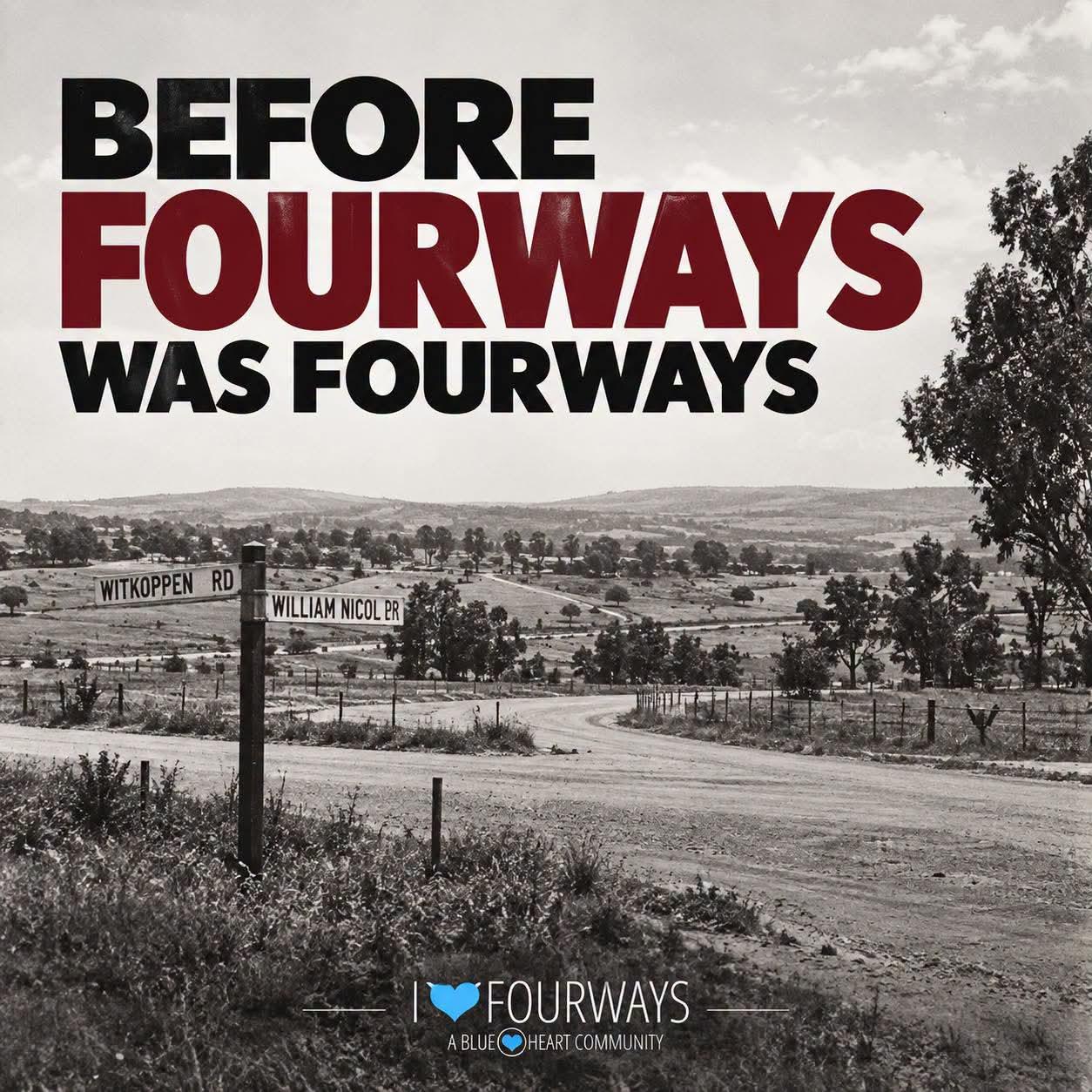
The name developed around the four-way stop at Witkoppen Road and what was then William Nicol Drive, now Winnie Mandela Drive.
That simple rural intersection would eventually become the centre of one of Johannesburg’s busiest commercial and residential areas.
The transformation happened remarkably quickly.
Fourways Mall arrived in 1994.
Montecasino opened in 2000, bringing a massive new entertainment development to the same Witkoppen intersection.
Farms and open land steadily gave way to homes, shopping centres, schools, restaurants, offices and the Fourways we recognise today.
And remarkably, one piece of that earlier Fourways is still here.
Norscot Manor survives today as part of the Norscot Manor Recreation Centre, giving us a physical link to a time when this corner of Johannesburg looked very different.
So next time you’re crawling along Witkoppen, spare a thought for the watermelons, Friesian cattle and country estates that came before us.
Fourways has changed a lot in less than 100 years.
What part of its history should we dig into next?
#Fourways #FourwaysHistory #JohannesburgHistory
It’s hard to imagine when you’re sitting in Fourways traffic today, but less than a century ago, much of the area around us was open countryside.
And the story of how Fourways became Fourways is a fascinating one.
In 1935, Ernst and Ethel Eriksen travelled north from Johannesburg looking for land on which to build a home. They found part of the old Witkoppen farm, where the Van der Walt brothers were farming watermelons and Friesian cattle.
Ethel reportedly fell in love with the views towards the Magaliesberg and the sunsets. Ernst initially bought 423 acres, with the property later growing to around 605 acres.
They called their home Norscot, a name combining Norway and Scotland, reflecting the family’s Norwegian and Scottish connections.
Construction began in 1936, and Norscot eventually became an extraordinary country residence with eight reception rooms, six bedrooms and five bathrooms.
At the time, this really was the countryside.
Even into the 1950s, the area was considered well outside Johannesburg, and accounts of Fourways in the 1970s still describe working farms, open fields and dairy cattle being walked down to the Jukskei River.
SO WHERE DID “FOURWAYS” COME FROM?
The name developed around the four-way stop at Witkoppen Road and what was then William Nicol Drive, now Winnie Mandela Drive.
That simple rural intersection would eventually become the centre of one of Johannesburg’s busiest commercial and residential areas.
The transformation happened remarkably quickly.
Fourways Mall arrived in 1994.
Montecasino opened in 2000, bringing a massive new entertainment development to the same Witkoppen intersection.
Farms and open land steadily gave way to homes, shopping centres, schools, restaurants, offices and the Fourways we recognise today.
And remarkably, one piece of that earlier Fourways is still here.
Norscot Manor survives today as part of the Norscot Manor Recreation Centre, giving us a physical link to a time when this corner of Johannesburg looked very different.
So next time you’re crawling along Witkoppen, spare a thought for the watermelons, Friesian cattle and country estates that came before us.
Fourways has changed a lot in less than 100 years.
What part of its history should we dig into next?
#Fourways #FourwaysHistory #JohannesburgHistory
FROM WATERMELON FARMS TO FOURWAYS
It’s hard to imagine when you’re sitting in Fourways traffic today, but less than a century ago, much of the area around us was open countryside.
And the story of how Fourways became Fourways is a fascinating one.
In 1935, Ernst and Ethel Eriksen travelled north from Johannesburg looking for land on which to build a home. They found part of the old Witkoppen farm, where the Van der Walt brothers were farming watermelons and Friesian cattle.
Ethel reportedly fell in love with the views towards the Magaliesberg and the sunsets. Ernst initially bought 423 acres, with the property later growing to around 605 acres.
They called their home Norscot, a name combining Norway and Scotland, reflecting the family’s Norwegian and Scottish connections.
Construction began in 1936, and Norscot eventually became an extraordinary country residence with eight reception rooms, six bedrooms and five bathrooms.
At the time, this really was the countryside.
Even into the 1950s, the area was considered well outside Johannesburg, and accounts of Fourways in the 1970s still describe working farms, open fields and dairy cattle being walked down to the Jukskei River.
SO WHERE DID “FOURWAYS” COME FROM?
The name developed around the four-way stop at Witkoppen Road and what was then William Nicol Drive, now Winnie Mandela Drive.
That simple rural intersection would eventually become the centre of one of Johannesburg’s busiest commercial and residential areas.
The transformation happened remarkably quickly.
Fourways Mall arrived in 1994.
Montecasino opened in 2000, bringing a massive new entertainment development to the same Witkoppen intersection.
Farms and open land steadily gave way to homes, shopping centres, schools, restaurants, offices and the Fourways we recognise today.
And remarkably, one piece of that earlier Fourways is still here.
Norscot Manor survives today as part of the Norscot Manor Recreation Centre, giving us a physical link to a time when this corner of Johannesburg looked very different.
So next time you’re crawling along Witkoppen, spare a thought for the watermelons, Friesian cattle and country estates that came before us.
Fourways has changed a lot in less than 100 years.
What part of its history should we dig into next?
#Fourways #FourwaysHistory #JohannesburgHistory