


Caracal (Scientific Name: Caracal caracal): The Acrobatic Phantom of the Wild

Few predators combine elegance, power, and precision quite like the caracal. Often called the “desert lynx”, this striking feline is instantly recognizable by its long, black-tufted ears and athletic prowess. Yet despite its lynx-like appearance, the caracal belongs to its own distinct lineage, one perfectly adapted to thrive across some of the harshest landscapes on Earth.
Physical Description
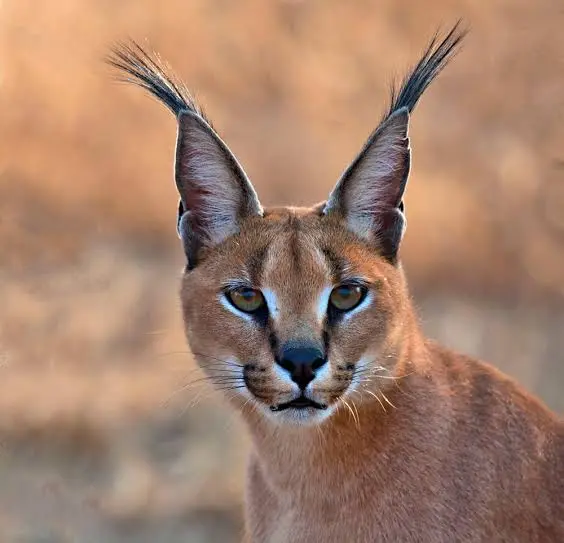
The caracal is a medium-sized wild cat with a sleek, muscular build designed for speed and agility. Its coat is short and dense, typically a rich tawny-brown to brick-red color that blends seamlessly into dry grasslands and scrub. Rare melanistic (all-black) individuals have also been recorded, adding to the mystique of this already captivating species.
Its most iconic feature is its ears, large, expressive, and tipped with black tufts about 4–5 cm (roughly 1.75 inches) long. The backs of the ears are jet black, giving rise to the name caracal, derived from the Turkish word karakulak, meaning “black ear.” Unlike true lynxes, however, the caracal lacks the prominent facial ruff.
Size and Weight
Caracals are among the largest of Africa’s small cats and are impressively built:
- Shoulder Height: 40–50 cm
- Body Length: 61–106 cm (plus a 23–34 cm tail)
- Weight:
- Males: 8–20 kg
- Females: 6–16 kg
Their strong hind legs and compact bodies make them formidable hunters capable of explosive bursts of speed and incredible leaps.
Unique Adaptations
The caracal is a model of evolutionary efficiency, equipped with several remarkable adaptations:
- Acrobatic Hunting: They can leap up to 3 meters into the air to snatch birds mid-flight, a skill that has made them legendary among hunters.
- Precision Hearing: Over 20 muscles control each ear, allowing them to pinpoint even the faintest sounds.
- Desert Survival: Specialized stiff hairs between their paw pads help them move easily across sand. They can also survive long periods without drinking water, obtaining moisture from their prey.
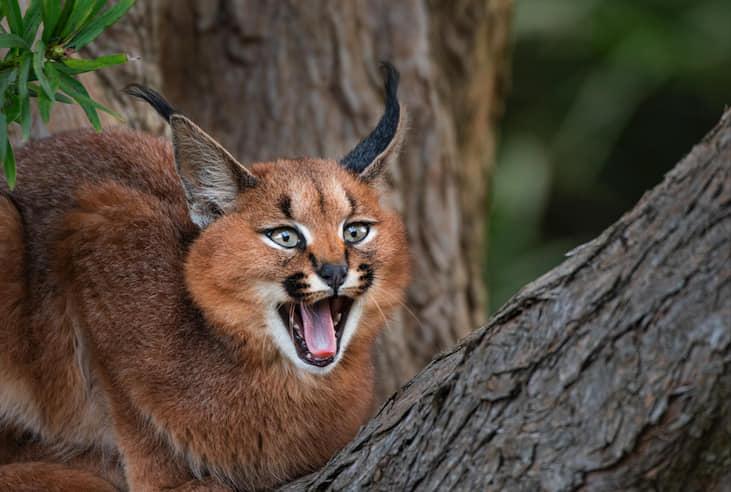
- Climbing Ability: Though primarily ground hunters, they can climb trees to store food safely away from scavengers.

Distribution and Habitat
Caracals have a broad geographic range, spanning:
- Africa (especially Southern and Eastern regions)
- The Arabian Peninsula
- Central Asia and parts of India
They thrive in diverse habitats such as dry woodlands, scrublands, semi-deserts, and even mountainous regions up to 3,300 meters. However, they avoid extreme environments like dense tropical rainforests and vast sandy deserts such as the central Sahara.
While stable in parts of Africa, populations in North Africa, the Middle East, and Asia are declining due to habitat loss and human pressures.
Social Structure and Behaviour
Caracals are primarily solitary and nocturnal, although they may be active during the day in cooler climates or protected areas. Each adult maintains a large territory marked by scent and scratch marks.
- Males have larger territories that may overlap with several females.
- Females raise their young alone, with kittens staying for 9–12 months before becoming independent.
Their elusive nature and stealth make them one of the more mysterious wild cats.
Diet and Feeding
Caracals are opportunistic hunters with a varied diet, including:
- Rodents and hares
- Hyraxes
- Small antelope (e.g., springbok, young kudu)
- Birds, reptiles, and even fish
Their bird-hunting ability is particularly famous, as they can knock multiple birds out of the air in a single leap. Occasionally, they store prey in trees, a behavior more commonly associated with leopards.

Reproduction and Lifespan
Caracals do not have a strict breeding season, though births often coincide with rainy periods when prey is abundant.
- Gestation: 2.5 months
- Litter Size: 1–4 kittens
- Weaning: Around 10 weeks
- Independence: 9–12 months
- Sexual Maturity: 12–16 months

Lifespan:
- Wild: 10–12 years
- Captivity: 15–20 years
Threats and Survival
Despite their adaptability, caracals face several threats:
- Predation by larger carnivores and pythons
- Habitat destruction
- Human conflict, especially in agricultural areas
Their survival depends heavily on prey availability and the preservation of suitable habitats.
Conclusion
The caracal is a remarkable blend of beauty, strength, and adaptability. From its iconic black-tufted ears to its gravity-defying leaps, it stands as one of nature’s most skilled and efficient predators. While still relatively stable in parts of Africa, the species faces increasing challenges elsewhere. Protecting the caracal means preserving not just a species, but a symbol of resilience in some of the world’s most demanding environments.


- News & Current Affairs
- Business & Economy
- Finance & Money
- Education & Learning
- Technology & Innovation
- Science & Environment
- Health & Wellness
- Food & Drink
- Home, Garden & Lifestyle
- Travel & Tourism
- Fashion & Beauty
- Art & Culture
- Entertainment & Media
- Sports & Recreation
- Personal Growth & Lifestyle
- Careers & Work
- Tutorials & How-To Guides
- Real Estate & Property
- Automotive
- Family & Relationships
- Environment & Sustainability
- Law & Legal Matters
- Gaming & Esports
- Religion & Spirituality
- Community & Local Voices
- Miscellaneous
- History