


Nikola Tesla: The Visionary Who Powered the Modern World

Nikola Tesla (1856–1943) was one of history’s most brilliant, and misunderstood inventors. A Serbian-American engineer and physicist, Tesla transformed how the world generates and uses electricity, most famously through his development of alternating current (AC) power systems. Though he died poor and largely forgotten, his ideas now underpin modern electrical grids, radio, wireless technology, and countless innovations of the 21st century.

Early Life and a Restless Mind
Tesla was born on July 10, 1856, in Smiljan, then part of the Austrian Empire (modern day Croatia), to Serbian parents. His father was a Serbian Orthodox priest, while his mother, though uneducated formally, was a gifted inventor in her own right, creating household tools that deeply influenced Tesla’s curiosity.
A defining tragedy struck early: the death of Tesla’s older brother in a riding accident. The shock haunted him for life and coincided with vivid visions and intense mental imagery, abilities that later allowed Tesla to design machines entirely in his mind before building them.
He studied engineering at the Technical University of Graz and later attended the University of Prague, though he never completed a formal degree. What Tesla lacked in credentials, he more than made up for in raw intellect, photographic memory, and imagination.
From Europe to America
In 1882, while walking in a park, Tesla conceived the idea for a brushless AC motor, sketching rotating magnetic fields in the sand, an invention years ahead of its time.
After working on DC power systems in Paris, Tesla emigrated to the United States in 1884, arriving in New York with little money but enormous ambition.
Tesla and Edison: A Clash of Visions
Shortly after arriving, Tesla was hired by Thomas Edison. Their partnership was brief and tense. Edison favored direct current (DC) systems, while Tesla believed AC was superior for long-distance power transmission.
When Edison allegedly refused to pay Tesla for improving DC dynamos, Tesla quit, setting the stage for the famous “War of Currents.”
The War of Currents and Westinghouse
After struggling financially (including a period digging ditches for $2 a day), Tesla found support from George Westinghouse, who recognized the brilliance of Tesla’s AC system.
Tesla’s patents for the AC induction motor and polyphase power system proved decisive. Despite Edison’s aggressive, and sometimes unethical campaigns against AC, Tesla and Westinghouse ultimately won. Their triumph was cemented when AC generators powered:
- The 1893 World’s Columbian Exposition in Chicago
- The Niagara Falls power station, the first modern hydroelectric plant
AC became, and remains the global standard for electricity.
A Mind Far Ahead of Its Time
Beyond AC power, Tesla invented or advanced:
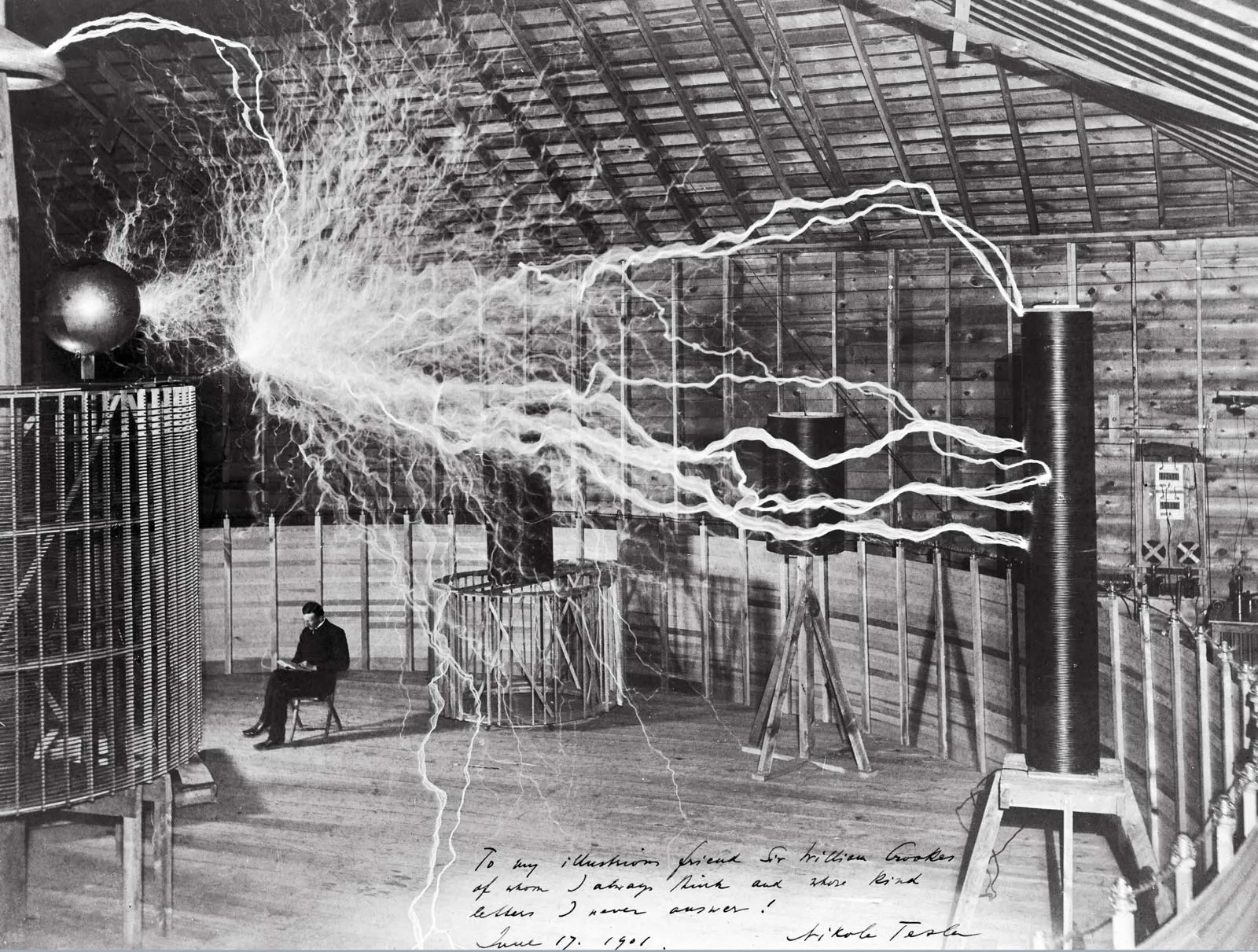
- The Tesla Coil, foundational to radio and wireless transmission
- Early radio communication, later acknowledged by the U.S. Supreme Court
- Wireless lighting, X-ray experimentation, and remote control
- High-frequency oscillators and electrical meters
In 1895, a fire destroyed his New York laboratory, wiping out years of research. Undeterred, Tesla continued working, often on ideas so ambitious they exceeded the technology of his era.
Decline, Isolation, and Eccentric Genius
By the early 1900s, Tesla’s fortunes faded. A grand wireless communication project at Wardenclyffe Tower, backed initially by J.P. Morgan, collapsed when funding was withdrawn.
Tesla spent his final decades living in New York hotels, increasingly isolated. His obsessive habits, fixation on the number three, and deep affection for pigeons became legend. Despite his declining health and finances, he never stopped inventing.
Tesla died alone on January 7, 1943.
Recognition After Death
Later in 1943, the U.S. Supreme Court invalidated key radio patents held by Marconi, effectively recognizing Tesla’s priority in radio technology. Though the recognition came too late for him, history has since restored Tesla’s reputation.
Today, Tesla is celebrated as:
- A pioneer of modern electrical engineering
- A prophet of wireless communication
- A symbol of visionary genius unbound by convention
His name lives on in the Tesla electric car company, scientific units, and popular culture.
Final Thoughts
Nikola Tesla was a man who saw the future, and paid the price for seeing it too early. His life is a reminder that transformative ideas do not always bring immediate reward, and that genius often walks hand in hand with isolation.
Though he died poor, Tesla lit the world. Every time a switch is flipped and power flows effortlessly across continents, his legacy hums quietly in the background, unchallenged, indispensable, and enduring.


- News & Current Affairs
- Business & Economy
- Finance & Money
- Education & Learning
- Technology & Innovation
- Science & Environment
- Health & Wellness
- Food & Drink
- Home, Garden & Lifestyle
- Travel & Tourism
- Fashion & Beauty
- Art & Culture
- Entertainment & Media
- Sports & Recreation
- Personal Growth & Lifestyle
- Careers & Work
- Tutorials & How-To Guides
- Real Estate & Property
- Automotive
- Family & Relationships
- Environment & Sustainability
- Law & Legal Matters
- Gaming & Esports
- Religion & Spirituality
- Community & Local Voices
- Miscellaneous
- History