


How Locust Plagues Form — and How They’re Stopped

Locusts are usually just ordinary grasshoppers living quiet, solitary lives. But under the right (or wrong) environmental conditions, they can undergo one of nature’s most dramatic transformations — turning into massive, destructive swarms capable of darkening the sky and devastating crops across entire regions.
Here’s how locust plagues form, why they become so dangerous, and what can be done to stop them.

How Locust Plagues Form
1. Perfect Breeding Conditions
Locust plagues usually begin after long droughts are followed by unusually heavy rains, often from tropical storms or cyclones.
The sudden burst of rainfall creates lush vegetation and moist soil — the perfect environment for locust egg-laying and rapid population growth.
2. Crowding and Contact
As vegetation begins to dry up again, thousands of young locusts (hoppers) crowd into shrinking patches of food.
This close contact — especially repeated touching of their hind legs — triggers a powerful chain reaction in their nervous system.
3. The Phase Change: Solitary to Gregarious
Physical crowding causes the locusts’ bodies and behavior to change dramatically. Higher levels of serotonin shift them from shy, solitary insects to bold, social, hyperactive ones.
They also change colour, often turning bright yellow and black.
4. Formation of Bands and Swarms
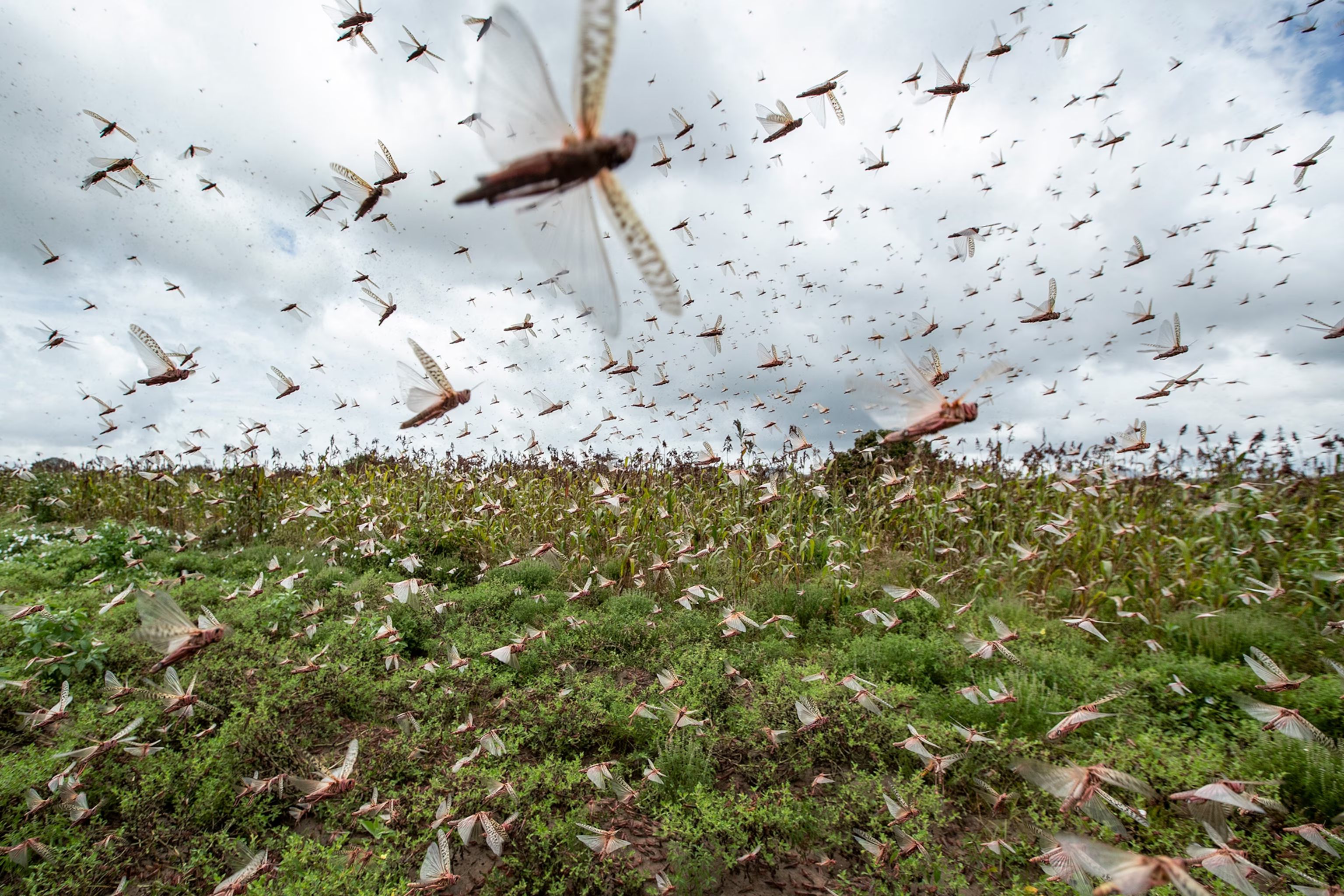
The gregarious hoppers gather into marching “bands.” Once they mature into adults with wings, they form enormous flying swarms.
A single swarm can travel up to 150 km per day and eat its own body weight in vegetation — every day.
5. Regional Plague Development
If swarms continue breeding successfully across multiple areas and seasons, isolated outbreaks merge into a full-scale plague.
These plagues can last months or even years, destroying crops and threatening food security across entire countries.
How Locust Plagues Are Stopped
Once a plague forms, stopping it becomes extremely difficult. The most effective method is early detection and prevention, before the population explodes.
1. Monitoring and Early Warning
National teams and global agencies such as the FAO track locust breeding conditions using:
- satellite data
- drones
- field surveys
- weather and vegetation models

This helps target areas before swarms develop.
2. Chemical Spraying
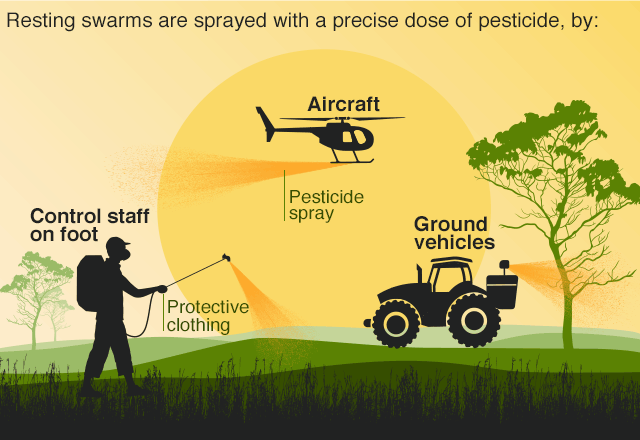
Ultra-low-volume (ULV) insecticides sprayed from aircraft or ground vehicles remain the fastest, most effective method for controlling large swarms, particularly when hoppers are still young and flightless.
3. Biological Control
Eco-friendly options like Metarhizium acridum (a naturally occurring fungus) infect and kill locusts slowly.
These biopesticides are safer for people and wildlife but work best on small-scale outbreaks.
4. Mechanical and Traditional Methods
Farmers may dig trenches, use hopper-trapping devices, or attempt to herd flightless nymphs — methods that help locally but are rarely enough to stop a large upsurge.
Natural Ways a Plague Ends
Sometimes nature steps in where humans struggle. Plagues tend to collapse when the environment turns hostile again.
Extended dry periods, cold weather, shifting winds, or a sudden lack of vegetation interrupt breeding cycles and starve out swarms.
Final Thoughts
Locust plagues are ancient, powerful natural events — but today, with coordinated monitoring and quick action, many potential plagues can be stopped before they begin. Early detection remains the real key. Once swarms are in the air, control becomes far more difficult, expensive, and destructive.
With smarter surveillance, biological solutions, and improved forecasting, the world is better prepared than ever to prevent these incredible insects from becoming a global threat.


- News & Current Affairs
- Business & Economy
- Finance & Money
- Education & Learning
- Technology & Innovation
- Science & Environment
- Health & Wellness
- Food & Drink
- Home, Garden & Lifestyle
- Travel & Tourism
- Fashion & Beauty
- Art & Culture
- Entertainment & Media
- Sports & Recreation
- Personal Growth & Lifestyle
- Careers & Work
- Tutorials & How-To Guides
- Real Estate & Property
- Automotive
- Family & Relationships
- Environment & Sustainability
- Law & Legal Matters
- Gaming & Esports
- Religion & Spirituality
- Community & Local Voices
- Miscellaneous
- History