


Meerkat (Suricata suricatta): Desert Sentinel of Southern Africa

The Meerkat is one of southern Africa’s most recognizable and charismatic small mammals. Famous for their upright “sentry” pose, meerkats are highly social mongooses that thrive in some of the harshest desert environments on Earth.
From cooperative childcare to complex alarm calls, these desert dwellers demonstrate remarkable teamwork and adaptability.

Physical Description
Meerkats are small, slender-bodied mammals with short legs and long, pointed faces. Their fur is typically grizzled grey, tan, or light brown, helping them blend seamlessly into arid landscapes.
Faint, broken dark stripes run across their backs, while distinctive dark patches around their eyes act like natural sunglasses, reducing glare from the intense desert sun.
Size & Weight:
- Head and body length: 25–35 cm (10–14 inches)
- Tail length: 17–25 cm
- Weight: 0.6–1 kg (1.4–2.2 pounds)
Their thin tail, tipped in black, is not bushy like many mongooses and serves as a stabilizer when standing upright.
Unique Adaptations
- Dark eye patches reduce sun glare.
- Closable ears keep out sand during digging.
- Strong claws (especially on front feet) allow efficient excavation.
- Horizontal pupils provide a wide field of vision for spotting predators.
- Thermoregulation patch on the belly helps absorb warmth in cool mornings.
- Partial venom resistance allows them to hunt scorpions and snakes.
Distribution and Habitat
Meerkats are endemic to southern Africa, particularly:
- South Africa
- Botswana
- Namibia
- Southern Angola
They are strongly associated with the Kalahari Desert, the Karoo, and surrounding semi-arid regions.
Preferred Habitat
- Open savannas and scrublands
- Sparse vegetation with short grasses
- Firm or stony soil suitable for burrowing
- Arid climates with low annual rainfall (under 600 mm)
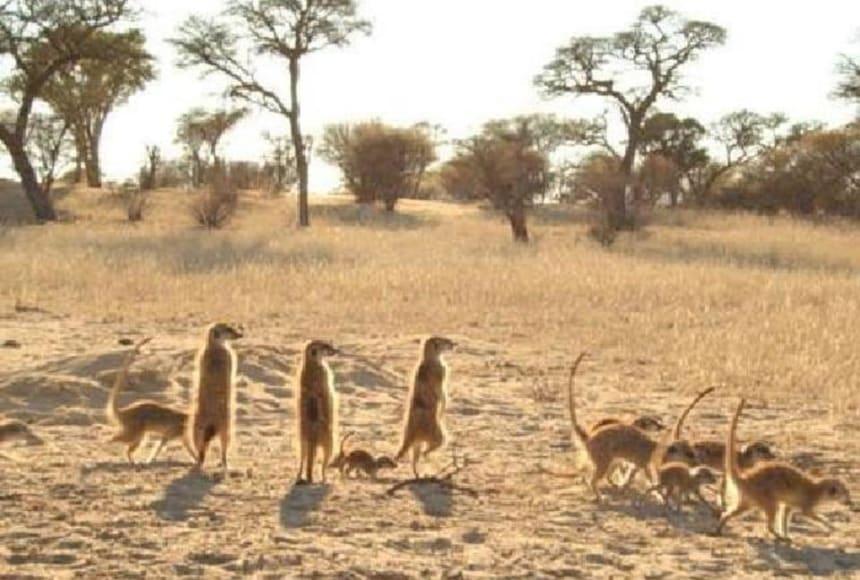
They live in complex underground burrow systems with multiple entrances, which protect them from predators and extreme temperatures.
Social Structure and Behaviour
Meerkats are highly social and live in groups known as mobs, gangs, or clans, ranging from 2 to 50 individuals. Groups are led by a dominant female, who is typically the primary breeder. A dominant male is her mate, and together they produce most of the offspring.
Subordinate members assist with:
- Babysitting
- Feeding pups
- Guarding the burrow
- Acting as sentinels
This cooperative breeding system is one of the most remarkable examples of social behaviour in mammals.
Meerkats possess more than ten distinct vocalizations, including predator-specific calls for aerial or ground threats.
Diet and Feeding
Meerkats are primarily insectivores but are technically carnivorous omnivores.
Main Diet
- Beetles, grubs, termites
- Spiders and centipedes
- Scorpions
- Small reptiles
- Bird eggs
- Occasional small mammals

Approximately 80% of their diet consists of insects.
They spend 5–8 hours daily foraging, digging with powerful claws while using their sensitive noses to locate prey. While others forage, one meerkat stands upright on guard, scanning for predators such as eagles, jackals, and snakes. If danger is spotted, they issue specific alarm calls.
Meerkats possess more than ten distinct vocalizations, including predator-specific calls for aerial or ground threats.
Water Intake
Meerkats rarely drink standing water. Instead, they obtain moisture from:
- Insects
- Roots and tubers
- Tsama melons
Reproduction and Lifespan
Meerkats breed throughout the year, with peak breeding during warm, rainy months (August–March).
- Gestation: 10–11 weeks
- Litter size: Typically 2–5 pups (up to 8 possible)
- Birth weight: Small, blind, and hairless
Pups:
- Open eyes at ~2 weeks
- Emerge from burrow at 3–4 weeks
- Wean at 6–9 weeks
- Reach sexual maturity around 1 year
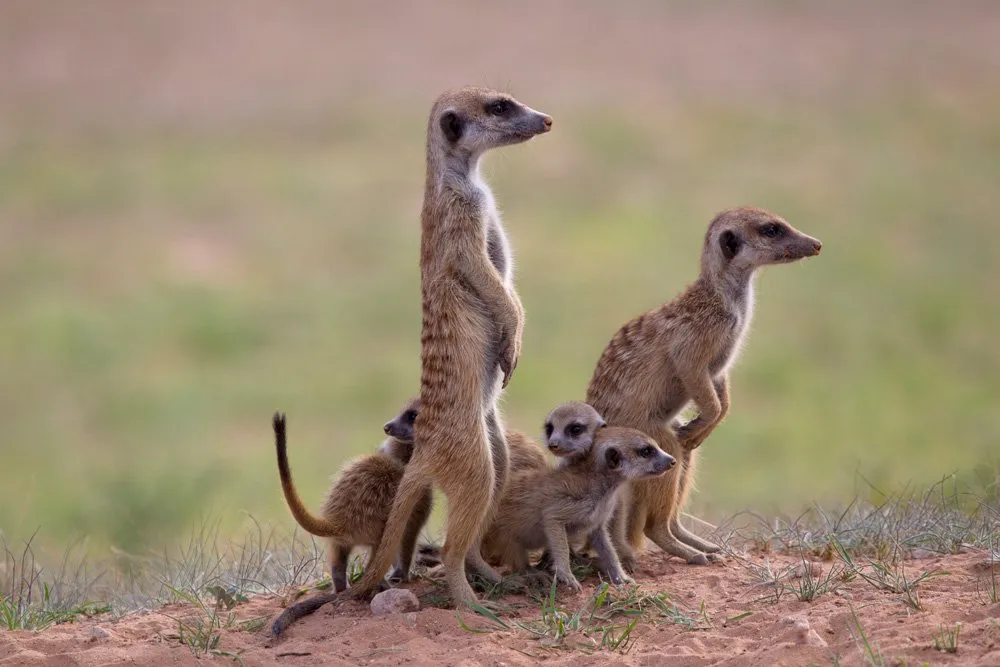
Adults actively teach pups how to handle dangerous prey such as scorpions, an advanced learning behaviour rarely seen outside primates.
- Wild lifespan: 10–15 years (many do not survive first year)
- Captivity: 15–20 years possible
High mortality is common due to:
- Predation
- Starvation
- Infanticide by dominant females
- Territorial conflicts
Despite these risks, their cooperative lifestyle significantly increases survival chances.
Conclusion
The meerkat is far more than a cute desert animal standing upright on watch. It represents one of nature’s most advanced examples of cooperation, communication, and social organization.
Perfectly adapted to harsh desert conditions, meerkats rely on teamwork, vigilance, and complex social bonds to survive. Their intelligence and resilience make them one of southern Africa’s most fascinating small mammals and a true icon of the Kalahari.


- News & Current Affairs
- Business & Economy
- Finance & Money
- Education & Learning
- Technology & Innovation
- Science & Environment
- Health & Wellness
- Food & Drink
- Home, Garden & Lifestyle
- Travel & Tourism
- Fashion & Beauty
- Art & Culture
- Entertainment & Media
- Sports & Recreation
- Personal Growth & Lifestyle
- Careers & Work
- Tutorials & How-To Guides
- Real Estate & Property
- Automotive
- Family & Relationships
- Environment & Sustainability
- Law & Legal Matters
- Gaming & Esports
- Religion & Spirituality
- Community & Local Voices
- Miscellaneous
- History